Meadow heartwood
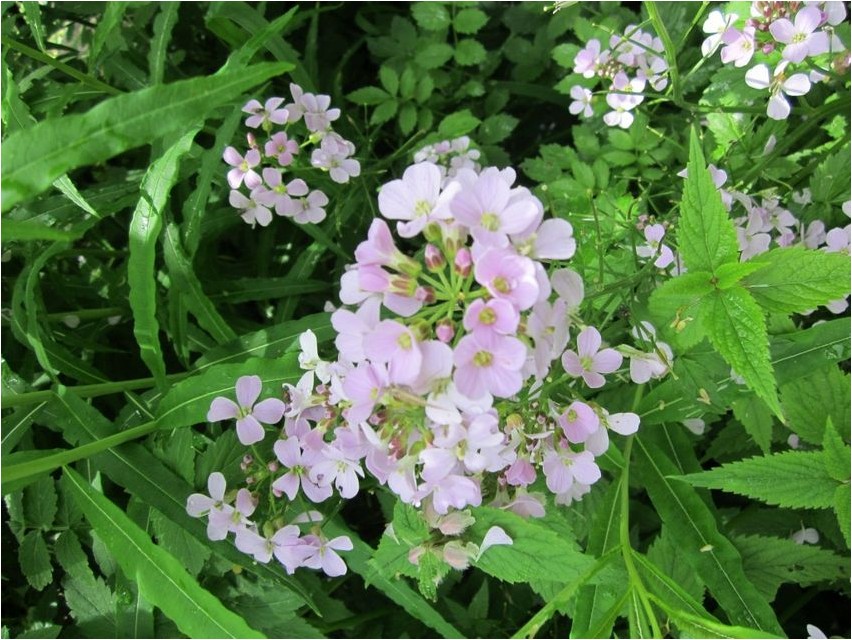
The meadow heart is one of the plants of the family called cabbage or cruciferous plants; in Latin the name of this plant will be as follows: Cardamine pratensis L.
As for the name of the meadow heart family itself, in Latin it will be: Brassicaceae Burnett. (Cruciferae Juss.).
Description of meadow core
Meadow heart is known by many popular names: field mustard, field cardamion, spring watercress, marsh watercress, gourd, white-flowered, undergrowth and smolyanka. Meadow heart is a perennial plant endowed with a rather short rhizome, the height of which will vary between fifteen and forty centimeters. The stem of such a plant is erect; it can be either simple or weakly branched in the upper part. The leaves of the meadow core will be odd-pinnate and endowed with four to ten pairs of leaflets. The basal leaves of this rosette-shaped plant will be endowed with long petioles and rounded leaves. At the same time, the stem leaves of the meadow core are short-petioled and they are endowed with linear-oblong leaflets, and the uppermost leaves are endowed with two to three pairs of linear leaflets. The flowers of this plant are collected in approximately ten to twenty flower racemes; at the very beginning of flowering, such a raceme will be corymbose, and over time it will stretch out. The white petals are endowed with purple veins, and their length will be ten to twelve millimeters. The stamens of the meadow core are, in turn, endowed with yellow anthers. The fruits of this plant are multi-seeded straight and linear pods that are located on oblique pedicels, and the length of such pods can reach four centimeters. The seeds of this plant are oblong-oval in shape, their diameter will be about one millimeter, and their length will be equal to one and a half millimeters. The seeds of the meadow heart are colored brownish or dark yellow.
This plant blooms in spring and early summer. Under natural conditions, meadow heartwood is found in the Far East, the mountains of Africa in Ethiopia, North America, the European part of Russia, Ukraine, Eurasia, Belarus, Western and Eastern Siberia. To grow, this plant prefers grassy swamps, wet meadows, and the banks of ponds and rivers.
Description of the medicinal properties of meadow core
The meadow heart is endowed with very valuable healing properties, and for medicinal purposes it is recommended to use the tops of the stems of this plant along with the flowers.
The presence of such valuable healing properties is recommended to be explained by the content of the roots and herbs of this plant of the glycoside glucocochlearin, which in turn contains sulfur. The flowers contain myrosin and gluconasturtium, and the grass contains ascorbic acid. In addition, myronic acid was found in the seeds of the meadow heart, and a glycoside is found in the roots of the grass.

Meadow heart is endowed with very effective anthelmintic, diuretic, antiscorbutic, anti-inflammatory, sedative, anticonvulsant and choleretic effects.
As for traditional medicine, this plant is quite widespread here. A decoction prepared from the meadow heart herb is indicated for use as a diaphoretic and stimulant, and is also used for inflammation of the upper respiratory tract and pneumonia. An infusion based on the flowers and flowering tops of the meadow heart is used as a choleretic and anthelmintic agent, and in addition, such a healing agent is effective for various skin diseases and rheumatism.





