catnip
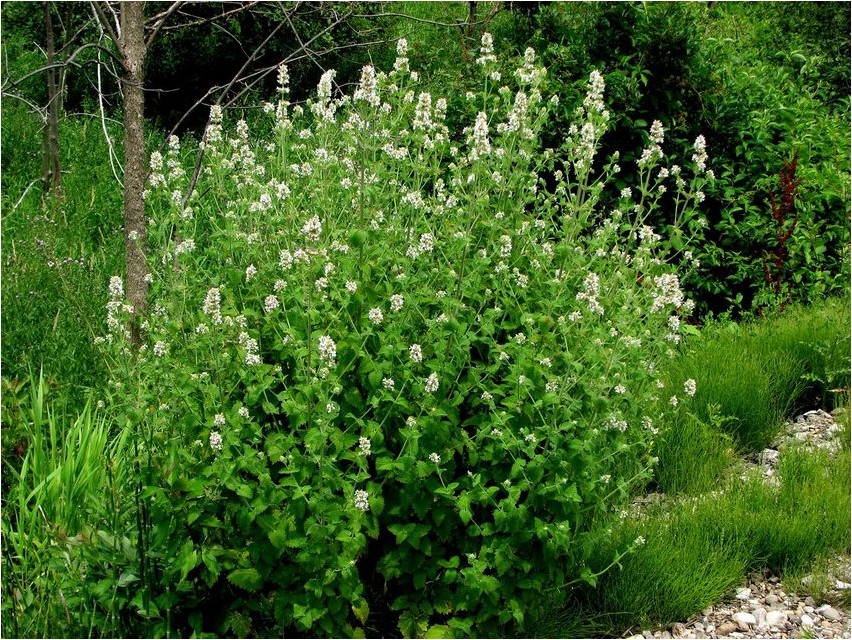
Catnip is one of the plants of the family called Lamiaceae; in Latin the name of this plant will be as follows: Nepeta cutaria L.
As for the name of the catnip family itself, in Latin it will be like this: Lamiaceae Lindl.
Description of catnip
Catnip is also known by the following popular names: catnip, sore grass, forest nettle, glushnyak, catnip, field mint, cat grass, matinee, mine, shenda and consumables. Catnip is a perennial herbaceous plant with a tetrahedral, erect, branching, velvety-pubescent stem. The length of such a stem of this plant will be about forty to one hundred and twenty centimeters. The leaves of this plant are coarsely toothed and triangular-heart-shaped, but below such leaves will be grayish in color, which is caused by dense pubescence. Catnip flowers will be two-lipped and whitish, they are small in size and collected in rather dense paniculate-spike-shaped inflorescences. It should be noted that this plant is endowed with a lemon smell and a spicy-bitter taste; such a plant will attract cats, in fact, this is what catnip owes its name to.
Catnip blooms from June to August. Under natural conditions, this plant is found in all regions of the European part of Russia with the exception of the northern regions, in the south of the Far East and in the south of Western Siberia, in Belarus, in Central Asia, the Caucasus and Ukraine. For growth, this plant prefers forest edges and weedy places, gardens, meadows and shrubs. It should be noted that catnip is a very valuable melliferous, medicinal and essential oil plant.
Description of the medicinal properties of catnip
Catnip is endowed with very valuable healing properties, and it is recommended to use the herb of this plant for medicinal purposes. The term herb includes the leaves, flowers and stems of catnip. Such raw materials should be harvested from June to August.
It is noteworthy that the chemical composition of this plant has not yet been fully studied. However, it is reliably known that this plant contains an essential oil that will contain citronellol, citral and geraniol.

As for traditional medicine, the infusion of this plant is quite widespread here. This infusion is recommended for use in cases of anemia, exhaustion, constipation, shortness of breath, chronic constipation, headaches, restless sleep, biliary and gastrointestinal colic, as well as to improve appetite and as an anthelmintic.
Externally, an infusion prepared from the catnip herb is recommended for washing small wounds, and in the form of compresses this remedy is used for abscesses and boils.
Catnip decoction is recommended for use for various gastric diseases, chronic bronchitis, melancholy, hysteria and menstrual disorders. The essential oil of this plant has become quite widespread in the perfume industry. For angina pectoris, stomach cramps and headaches, it is recommended to use the following remedy based on this plant: to prepare such a remedy, you will need to take two teaspoons of dry catnip herb per glass of boiling water. The resulting mixture should be infused for about forty to fifty minutes in a sealed container, after which the mixture should be filtered very carefully. Take the resulting remedy based on this plant three to four times a day, twenty minutes before meals, half a glass.