Anemone fork
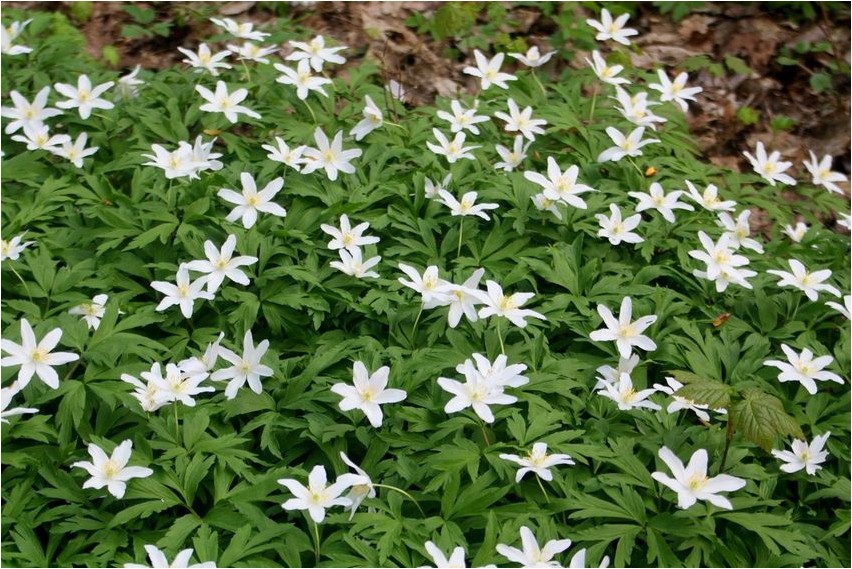
Anemone dichotoma L. is one of the plants of the family called Ranunculaceae; in Latin the name of this plant is as follows: Anemone dichotoma L.
As for the name of the family of this plant, in Latin it will be: Ranunculaceae Juss.
Description of the forked anemone
Anemone fork is a perennial herbaceous plant, the height of which will be about thirty to eighty centimeters. This plant is endowed with a thin rhizome, which will be black-brown in color. The stem of this plant is erect. The leaves of the anemone are opposite and sessile, and also deeply tripartite with lobes that can be either broadly lanceolate or oblong. The leaves of this plant are appressed along the edges and on the underside. The flowers will be single, they are on long peduncles, the diameter of which will be about two to three centimeters. The perianth has five elliptical leaflets, which are colored white, and sometimes they can be reddish below. The fruits of the anemone are compressed. This plant blooms from June to July.
This plant is found in the European part of Russia: in the Zavolzhsky and Volga-Kama regions, as well as in the Far East of Russia and in Western and Eastern Siberia. For growth, the forked anemone prefers flooded and damp meadows, harsh bush thickets, sparse forests and grassy swamps.
Description of the medicinal properties of forked anemone
This plant is endowed with quite valuable medicinal properties; for this purpose it is recommended to use the herb of anemone. The concept of grass includes the flowers, leaves and stems of this plant. It is recommended to harvest such raw materials and the roots of anemone throughout the entire flowering period.
The plant contains essential oils, saponins, alkaloids, flavonoids, vitamin C, gamma-lactone and cardenolides. It is noteworthy that fatty oil was found in the fruits of the anemone.

In Tibetan medicine, a decoction prepared from the herb of this plant has become quite widespread. This remedy is effective for a number of heart diseases, and for weak vision and hearing. As for the herbal infusion, it is recommended to use it for insomnia and tinnitus. External use of this herbal infusion has a therapeutic effect on erysipelas, various throat diseases and fungal skin diseases. It is noteworthy that this plant also has a hypotensive effect. In China, a decoction prepared from about three to six grams of anemone fork roots has become widespread: this remedy is used for diarrhea and as an intoxication for carbuncles. As for the external use of this remedy, a decoction of an arbitrary amount of anemone roots can be used as a compress for a variety of injuries.
To cure diarrhea, the following remedy is recommended: to prepare it, you will need to take six grams of crushed roots per glass of water. After this, the resulting mixture is boiled for five minutes, and then left to steep for one hour, after which the mixture is filtered. This mixture should be used one fourth of a glass three times a day.
For insomnia and tinnitus, the following remedy is recommended: take one tablespoon of chopped anemone herb per two glasses of boiling water. This mixture is infused for two hours and then filtered. It is recommended to take this remedy three to four times a day, one tablespoon.
Spring anemones: from A to Z. Crown anemone from planting tubers to flowering, and not only..
https://www. youtube. com/watch? v=GJVJj_RHoB8