Foxglove purpurea
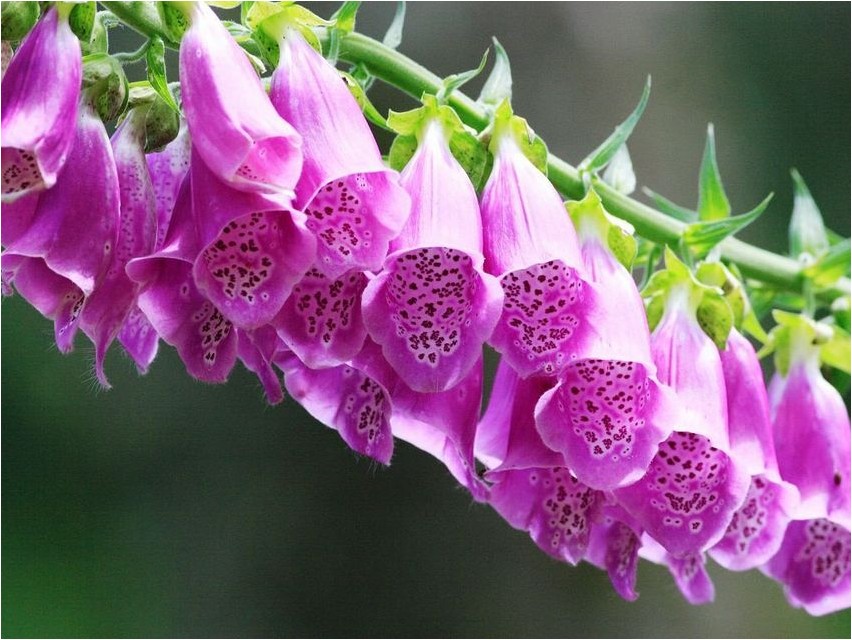
Foxglove purpurea is one of the plants of the family called Noricaceae; in Latin the name of this plant will be as follows: Digitalis purpurea L.
As for the name of the purple foxglove family itself, in Latin it will be: Scrophulariaceae Juss.
Description of foxglove purpurea
Foxglove purpurea is also known by the popular name thimble grass. Foxglove purpurea is a perennial or biennial herbaceous plant, endowed with a short rhizome and a fibrous root system. In the first year, this plant will develop a rosette of oblong, basal, oval or oblong-ovate leaves, which will be colored in dark green tones. The length of the leaves of such a plant will be about thirty centimeters, while the width will not exceed fifteen centimeters. In the second year, foxglove purpurea will produce erect, furrowed, leafy stems that will be velvety grayish with pubescence. The length of the lower stem leaves of foxglove purpurea will be about ten to twenty centimeters, such leaves will be long-petiolate and ovate, the middle leaves will be short-petiolate, and the upper ones will be sessile, either ovate or ovate-lanceolate. The edge of such leaves of this plant will be unevenly crenate. The upper surface of this leaf is painted in dark green tones. The color of foxglove purple leaves will be greyish-green underneath due to the abundance of hairs. At the top of the stem, the flowers of this plant will form a one-sided raceme. The flowers are quite large, they are purple in color and are collected at the very top in a one-sided brush.
The fruit of foxglove purple is an ovoid capsule endowed with wrinkled, oval-shaped seeds. This plant is native to Western Europe, and will be cultivated in the North Caucasus and Ukraine. It is noteworthy that foxglove purpurea is a poisonous plant, for this reason care should be taken when handling this plant.
Description of the medicinal properties of foxglove purpurea
Foxglove purpurea is endowed with very useful healing properties, and it is recommended to use the dried leaves of this plant for medicinal purposes. It should be noted that the presence of such valuable effective properties should be explained by the content of 62 cardiac glycosides in the aerial part of this plant.
It is important to remember that drugs created on the basis of this plant will be eliminated from the body rather slowly and have the ability to accumulate in tissues. For this reason, with prolonged use of drugs based on digitalis purpurea, the heart rate slows down to approximately a maximum of sixty per minute. There will also be a deterioration in the general condition, increased shortness of breath, a decrease in diuresis in the presence of edema, sleep disturbances, increased anxiety, as well as the appearance of rather unpleasant sensations in the heart area. If at least one of these symptoms occurs, drugs based on this plant should be immediately discontinued, after which potassium salts should be prescribed and atropine should be administered. In the future, it is important to carry out those activities that will restore normal heart activity.

However, digitalis purpurea turns out to be effective for chronic cardiovascular failure, which can have a completely different origin, ranging from myocarditis, mitral defects and ending with myocardial dystrophy. We should not forget to be careful when using such products.





