Honeysuckle
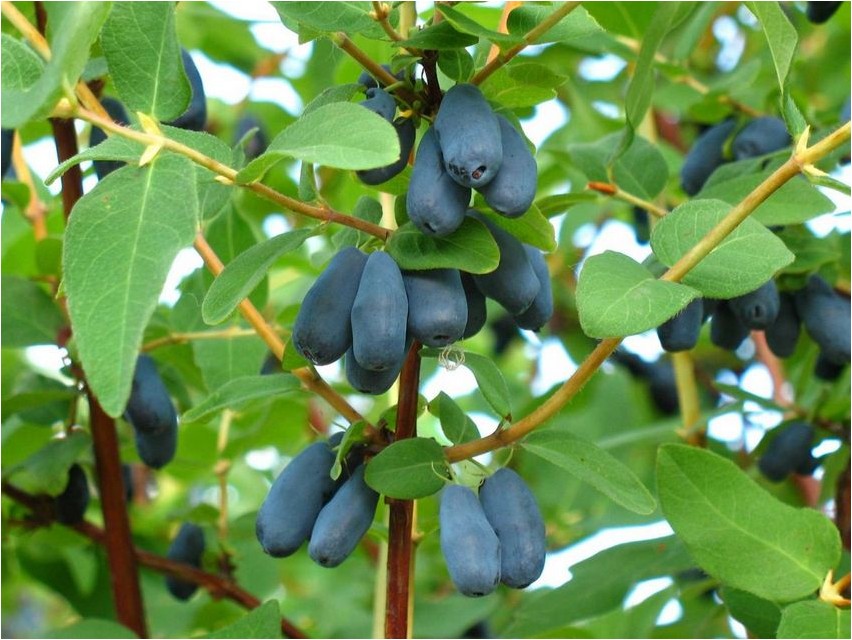
Honeysuckle (Lonicera) is a berry and ornamental shrub belonging to the Capsicum family.
Description
Honeysuckle is an upright or climbing shrub, reaching 150-200 cm in height. The branches are covered with brown bark, and the leaves are simple, elongated, and oval. The upper leaves of some varieties form a single blade through which the tip of the branch with flowers extends. The flowers are large, gathered in capitate inflorescences, and can be snow-white, cream, pink, yellow, or blue, arranged in pairs at the ends of branches or leaf corners. The fruits are elongated, cylindrical, dark blue with a bluish bloom, with a sweet and sour taste. They are used for food and for making jams and other preserves. Growing Conditions
Honeysuckle is a sun-loving plant, preferring well-lit areas. It thrives poorly in shady areas and produces low yields. Honeysuckle is highly winter-hardy, with flowers able to withstand spring frosts down t o-5 t o-7°C. Honeysuckle blooms very early, almost the first of many ornamental and berry crops to bloom.
Honeysuckle is an early ripening plant; its berries are ready for consumption in the first or second ten days of June. They don”t last long on the branches, falling quickly. The plant is undemanding, growing and thriving in virtually all soil types. Acidity also plays no significant role, although when grown in loamy soils, the fruits develop a slightly bitter taste.
Propagation and Planting
Honeysuckle is propagated by seeds, green cuttings, root suckers, and layering. Many gardeners prefer to grow honeysuckle from seeds, but experienced agronomists recommend using cuttings for this purpose, as they don”t require extensive treatment, easily establish a root system, and have time to fully prepare for winter. Furthermore, when propagated by seeds, honeysuckle doesn”t retain the characteristics of the mother plant.
Cuttings are taken from the middle of the shoot; their length should be 10 cm. A substrate for planting the cuttings is prepared in advance, combining fertile soil, river sand, and peat. The cuttings are inserted into the soil at an angle.
Rooted cuttings are planted in the area where the shrub is planned to be grown only after a couple of years; planting is best done in the fall. The crown should be buried 5 cm deep. The distance between seedlings should be 1. 5-2 m. Immediately after planting, the plants are watered and mulched with peat.

Care
Proper care is the key to obtaining high and high-quality honeysuckle yields. With the onset of heat, sanitary and formative pruning of shrubs is carried out. During the first 10 years of honeysuckle, it is recommended to remove only damaged and frostbitten branches. Then every year they shorten all the shoots, leaving up to 3 buds on them. Rejuvenating pruning is encouraged. In this case, the bushes are cut at a height of 30 cm above the soil surface.
For better growth and lush flowering, the crop needs regular fertilizing with mineral and organic fertilizers. Watering is carried out two to three times per season; in case of prolonged drought, the number of waterings is increased. Honeysuckle is also sensitive to soil compaction, so the crop must be loosened while removing weeds. Since honeysuckle is frost-resistant, it does not require shelter for the winter. Frozen plants recover quickly, with the exception of climbing varieties.
Disease and pest control
Honeysuckle is prone to disease and pest damage. The most dangerous plant aphid is the honeysuckle aphid. The first signs of damage: yellowing, curling and falling of leaves, cessation of shoot growth. To prevent the appearance of aphids on the crop, in early spring the bushes are sprayed with a decoction of yarrow. If damage cannot be avoided, the plants are treated with an infusion of hot pepper.
Among diseases, crops are often affected by powdery mildew. A white coating forms on the foliage, which subsequently descends to the stems. As a preventative measure, it is recommended to regularly loosen the soil, remove fallen leaves and treat the plants with a 1% solution of Bordeaux mixture. When the first signs of damage are detected, the honeysuckle is sprayed with biological products.
https://www. youtube. com/watch? v=BkdAtdq1PKA
honeysuckle honeysuckle





