Scots pine
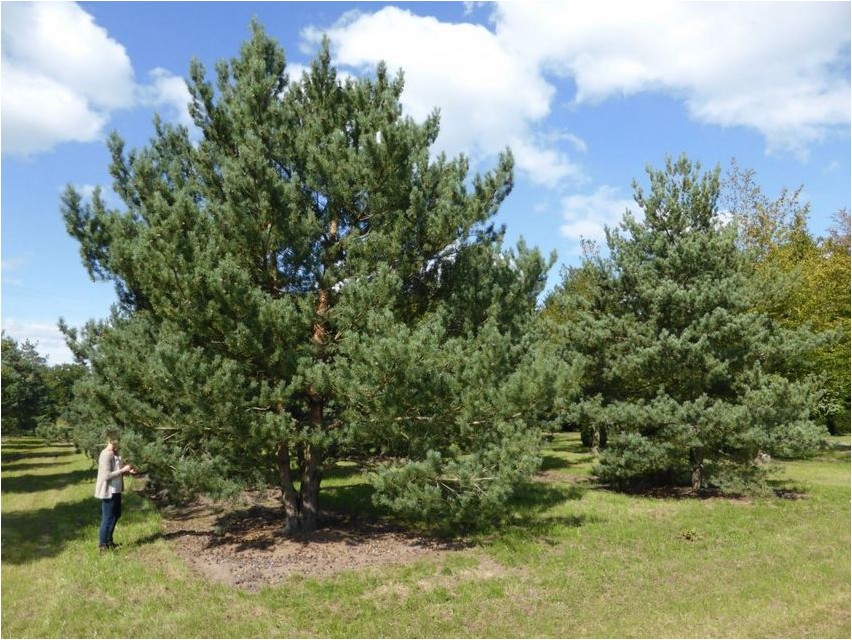
Scots pine is one of the plants of the family called pinaceae; in Latin the name of this plant will be as follows: Pinus sylvestris L.
As for the name of the Scots pine family itself, in Latin it will be: Pinaceae Lindl.
Description of Scots pine
Scots pine is an evergreen slender coniferous tree, the height of which will fluctuate between twenty and forty centimeters. In young trees the bark will be cone-shaped, while in older trees the bark is round and umbrella-shaped. The bark of Scots pine is colored red-brown, but on the branches it will be yellowish and flaking. The buds of this plant will be pointed and elongated ovoid, their length is six to twelve millimeters, such buds will be surrounded by triangular-lanceolate scales, endowed with a transparent membranous edge and painted in red-brown tones. The needles of this plant will be arranged in pairs, they are colored in bluish-green tones, are rigid and slightly curved, the length of the spines will be about four to seven centimeters, and the width will be approximately two millimeters. Scots pine blooms from the end of May to the beginning of June.
Under natural conditions, this plant is considered a fairly widespread Eurasian species and grows in Ukraine, Belarus and Russia.
Description of the medicinal properties of Scots pine
Scots pine is endowed with very valuable healing properties, and for medicinal purposes it is recommended to use young cones, young needles and buds of this plant.
As for traditional medicine, here this plant is quite widespread. Traditional medicine recommends using a decoction prepared from Scots pine buds for gout, bronchitis, pneumonia, rickets, dropsy, as well as for metabolic disorders that will be accompanied by a variety of skin diseases. In addition, this healing agent is also used as an antiscorbutic agent. It is noteworthy that pine buds are used to treat various wounds and are part of breast tea.

A decoction made from Scots pine bark is highly effective in treating malaria, while a decoction of the branches is used as an antitumor agent. A decoction made from unripe Scots pine cones is indicated for pulmonary tuberculosis. This decoction is also effective for gastric catarrh, radiculitis, various heart diseases, and gastric ulcers. The resin of this plant is also used to treat influenza, cancer, and stomach ulcers.
Turpentine baths are recommended for rheumatism, gout, arthritis, and salt deposits. Turpentine is also indicated for upper respiratory tract infections: compresses with Vaseline are applied to the chest.
Belarusian folk medicine uses the young shoots of this plant, as well as the inflorescences with unfallen pollen. Scots pine pollen should be steeped in alcohol, then brewed in boiling water, adding oil, honey, and sometimes even eggs. This remedy is effective for various lung ailments. Another acceptable remedy is to soak Scots pine resin in water and keep it in the sun for nine days, then use it for lung ailments. Both of these remedies are very effective when used correctly.