Acopisra (Foxtail)
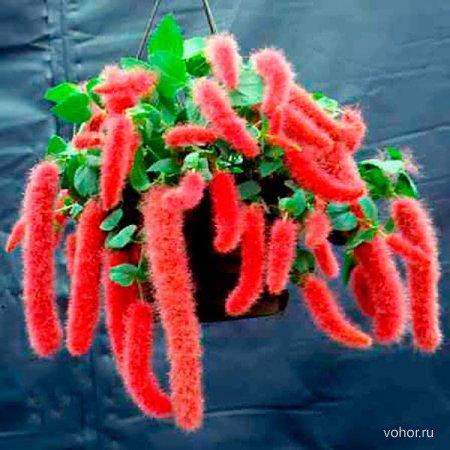 acalypha, or foxtail, is a houseplant in the Euphorbiaceae family. It is a shrub with fast-growing shoots. It is prized for its striking, brightly colored inflorescences and decorative, serrated leaves. Each variety differs in its leaves, which can be green with pubescence or brown with grayish spots. The leaves are oval and compact, depending on the pattern. The flowers are small, gathered in long, spike-shaped inflorescences.
Flowers come in red, orange, light, and cream colors. Flowering occurs in spring and summer. In favorable positions, some plants produce up to 25 inflorescences. The bush reaches a height of up to 150 cm. Low-growing varieties thrive, while others with drooping shoots are suitable for growing in hanging pots akalifa or foxtail belongs to indoor plants of the Euphorbiaceae family. Describes a shrub with fast-growing shoots. It is valued for its marvelous clear-colored inflorescences and decorative serrated leaves. The class is distinguished by leaves that are either green with pubescence or brown with grayish spots. According to the pattern, the leaves are oval and close. The flowers are small, collected in long spike-shaped inflorescences. Flowers come in red, orange, light, cream colors. Flowering is suitable for spring and summer. The presence of favorable conditions for a certain plant is formed before 25 inflorescences. The bush reaches a height of 150 cm, there are low-growing varieties, and also those with hanging shoots, suitable for growing in hanging pots. Popular waiting for Wilkes akalisra (wilkesiana) – distinguished by decorative green leaves with a bronze tint. The pointed, serrated leaves are covered with spots or light red along the sides and contain pubescence. Inflorescences up to 10 cm long.
Bristle (hispida) – valued for the clear fluffy inflorescences up to 50 cm long, red or light in color. The leaves are oval with serrated sides, dark green in color with pubescence. Care and cultivation of akalisra To grow foxtail, use a conglomerate of turf soil, leaf soil, peat, humus and sand in equal fractions. The soil for planting must be soft, nutritious and preferably drained. The pot is of medium volume with drainage ears; planting in hanging pots is marketable.
Akalifa refers to the number of heat-loving plants. During the warm period, the plant is fed at a temperature of 20-24 degrees Celsius; in winter, the air temperature should not get stuck below +18 degrees. The area is selected to be luminous, protected from direct sunlight. Akalifa suffers from drafts, but in summer the plant can be taken out for a new atmosphere. Foxtail is watered thoroughly, but do not allow stagnation of moisture. High level of soil due to watering is bound to dry out. In winter, watering is reduced until it is tolerable. For irrigation, use settled water at room temperature. The plant loves high air humidity (not less than 50%), so the foxtail is sprayed with lukewarm water, the pot is placed in a tray with sphagnum moss or expanded clay. During the flowering period, only the atmosphere around the plant is sprayed 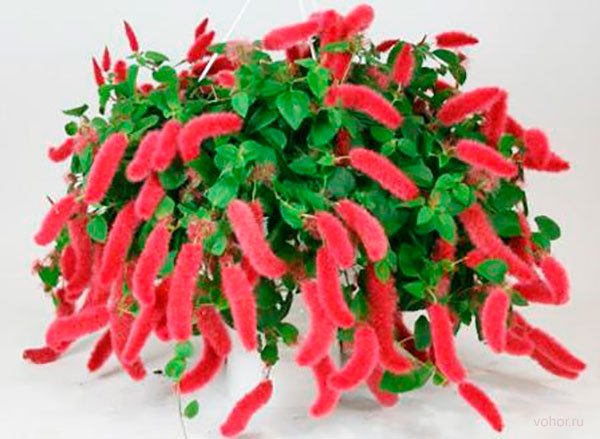 in summer, liquid mineral fertilizers are paid twice a month. In winter, Akalifa does not lack feeding. After flowering, in February the shoots are pruned, cutting almost 30 cm across the origin. Pruning is carried out with the target of rejuvenation. Subsequently, the remainder of the plant is sprayed with water. Every spring (at the beginning of spring, before the start of active growth), young plants are transplanted into a cold substrate; in adult specimens, only high-grade soil is replaced. Replanting adult plants with a substantial replacement of soil and doubling the volume of the pot is performed once at 4 years of age, or if the roots are quite dense and they begin to climb out through the drainage glasses. Propagation of Akalifu foxtail is carried out by cuttings or grains. Sowing of grains is carried out in March, in a mixture of leaf soil and sand. The grains are germinated in front of the film, at a temperature of almost 22-24 degrees Celsius, in a compartment with diffused light. The crops are constantly ventilated and watered according to the drying limit of the substrate. Grown seedlings dive into partial containers. The substrate used is gentle, from turf and leaf soil, sand.