Turkish cloves
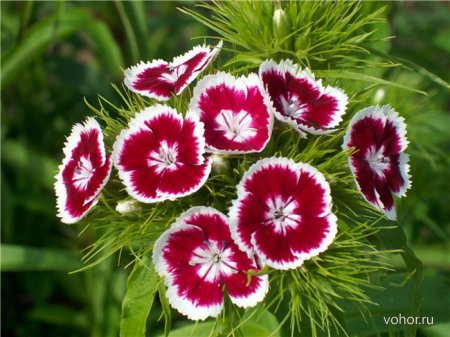 turkish carnation is a biennial plant and is valued for its ease of care, decorative flowering and pleasant delicate aroma. There are tall (up to 80 cm) and low-growing (up to 20 cm) varieties with different colors of flowers collected in inflorescences. There are varieties with double flowers.& nbsp;
Flowering is long lasting, lasting for 1. 5 months turkish carnation is a biennial plant and is valued for its ease of care, decorative flowering and pleasant delicate aroma. There are tall (up to 80 cm) and low-growing (up to 20 cm) varieties with different colors of flowers collected in inflorescences. There are also varieties with double flowers. Flowering is long lasting, lasting for 1. 5 months.
Care and cultivation of Turkish cloves
To achieve the greatest decorative effect, Turkish cloves are planted in sunny areas with useful, preferably drained and tender soil. The flower is talented at growing in light shade. Water sparingly, 1-2 times a week. In hot and dry conditions, watering is increased. Watering is performed before origin. It comes to mind that an excess of moisture has a detrimental effect on Turkish cloves. It is recommended to loosen the soil after watering.
Mineral fertilizers contribute to the presence of planting and only once in the spring of further age, it is possible to apply fertilizers during the budding period and during the flowering period of the Turkish carnation. Organic fertilizers in the form of compost and humus contribute to the planting, and also in the fall as mulch.
At the main age. In the fall, the plantings are mulched with a 10 cm layer of humus, sawdust, peat or other organic material. In the spring, when the plants begin to smell great, add mulch.
Reproduction

Turkish cloves are planted with grains. Sowing of grains takes place in June, immediately on public land. Before sowing, the land is prepared by digging and applying mineral and (or) organic fertilizers. The grains are planted in moistened grooves, almost 15 cm apart and almost 0. 5 cm apart. After planting, they are covered with film. Seedlings are watered according to the limit of need, without allowing the soil to dry out. After the emergence of seedlings, the film is removed and the plantings are thinned out if necessary. In the final stage, Turkish cloves are transplanted to the same area. At the main age, only rosettes are formed; flowering occurs at the next age after sowing. It is likely that grains will be sown before winter, around the end of October. In this incident, the crops are not watered.
Diseases and pests
As a result of poor, excessive watering, the basal roots may become unusable. Among the pests, spider mites are distinguished.