Azistasia
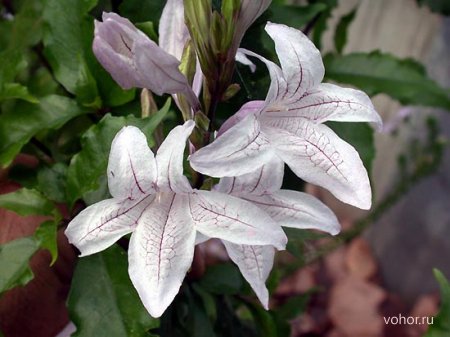 azistasia is an evergreen subshrub, reaching a height of about a meter, with erect shoots and oblong-oval, green leaves. The leaf boards, pointed for the crown, are jagged along the sides and extend to the stem with the support of low petioles. The upper shoots die off annually, but the repeat buds remain. Little by little, a semi-lignified main trunk is formed, and the adult plant begins to look like a small tree with hanging branches. But azistasia was previously grown only for its luxurious flowers, similar to large bells with petals widely open at the top and bent into the sides, luminous purple or light in color with contrasting veins. The flowers, one of which is almost 5 cm in diameter, are collected in huge axillary racemes. The length of some brushes is 12-20 cm. It blooms quite and luxuriously in spring and early in life, stubbornly captivating and striking everyone who understands it at this time in accordance with the truly miraculous forces, azistasia among indoor flowers can be encountered very quickly. Although it is not extremely capricious in its care, its beauty can outshine even the most well-known and popular ornamental flowering crops. Just like the majority of green pupils, whom their caring owners caress and pet on their windowsills, azistasia comes out of the evergreen tropics. Plants in this category, which includes almost 20 species, belong to the
Acanthaceae family and grow in natural positions in the tropical zone of South Africa. Asia and Oceania. Azistasia is an evergreen subshrub, reaching a height of about a meter, with erect shoots and oblong-oval, green leaves. The leaf boards, pointed for the crown, are jagged along the sides and extend to the stem with the support of low petioles. The upper shoots die off annually, but the repeat buds remain. Little by little, a semi-lignified main trunk is formed, and the adult plant begins to look like a small tree with hanging branches. But azistasia was previously grown only for its luxurious flowers, similar to large bells with petals widely open at the top and bent into the sides, luminous purple or light in color with contrasting veins. The flowers, one of which is almost 5 cm in diameter, are collected in huge axillary racemes. The length of some brushes is 12-20 cm. It blooms quite and luxuriously in spring and early in life, stubbornly captivating and striking everyone who understands it at this time.
Cultivated future of azistasia Until recently, it was taken into account that only one species from this category is cultivated in indoor floriculture – the beautiful azistasia; however, between the new products of 2013, its relative itself was also offered for sale – azistasia Gangetica, named for no reason after the glorious Ganges River in India. Externally, these two types can be easily distinguished according to the color of the flowers. In the beautiful azistasia they are lilac, and in the Gangetic one they are snow-white. Sometimes the name “azistasia” is used as a synonym for the plant Immersing excellent, the image of which indicates that its flowers can be not only pure and lilac, but also light. Most experts believe that this plant belongs to another genus of the Acanthaceae family, but a unified approach to their classification has not yet been developed. According to reviews of other flower growers and admirers, there is a variegated or variegated species of beautiful azystasia,