Bukashnik
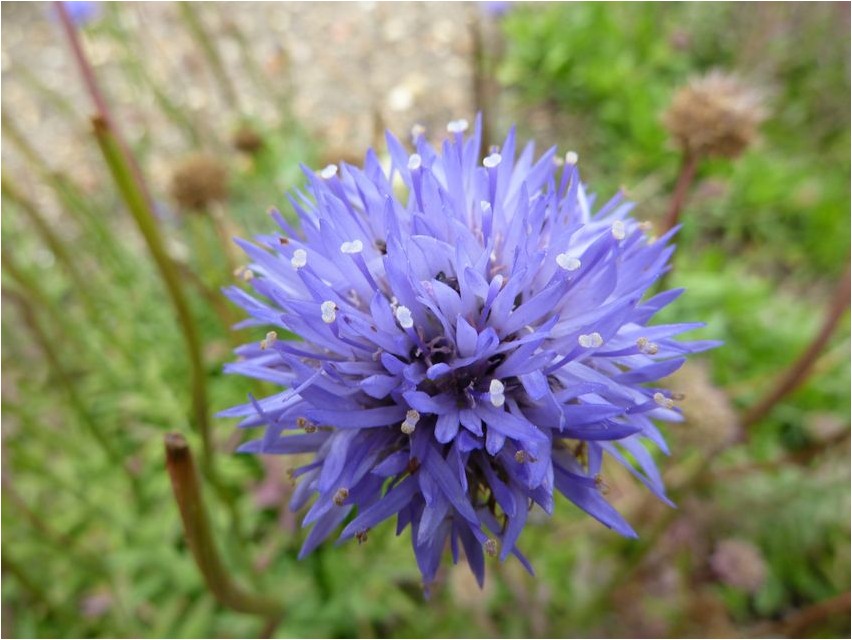
Bukashnik (lat. Jasione) is a genus of herbaceous plants belonging to the Bellflower family. Popularly, the plant is often called fainting grass, chistyakov, Ivanovo grass, and cyanosis.
In the natural environment, representatives of the genus are found in European countries and northern Africa. Typical habitats are hills and road edges. Almost all representatives of the genus are actively used in folk medicine.
Characteristics of culture
Beetle is represented by perennial and annual herbaceous plants, endowed with a highly branched stem, which becomes woody in the lower part over time. The foliage is alternate, green, jagged along the edge, the shape is different and depends on the species, collected in rosettes.
The flowers are small, collected in capitate inflorescences formed at the tips of the shoots. As a rule, one inflorescence contains over 200 flowers, often this number reaches 300 pieces. The flowers can be blue or blue in color. The fruits are presented in spherical capsules containing a large number of ovoid seeds with shine.
Common types
Curly beetle (lat. Jasione crispa) is one of the most common species. It is characterized by erect or ascending stems up to 30-35 cm high. The foliage of this species is lanceolate or ovoid, pubescent over the entire surface, collected in a not too lush rosette at the base. The flowers are blue, lilac or white.
Perennial bug (lat. Jasione laevis), like the previous representative of the genus, is a perennial. Its interesting feature is that it forms stolons, which during the rooting process form new lush rosettes of green, solid, flat, pointed foliage. The flowers are blue-purple, no more than 3 cm long, collected in spherical capitate inflorescences. One of those species that is used in floriculture. It is very relevant for the formation of rocky gardens.

Heldreich’s bug (lat. Jasione heldreichii) is a low-growing species, does not exceed 30 cm in height. The representative of the genus is endowed with erect stems and a basal rosette of lanceolate leaves. The flowers are small, blue, formed in huge numbers, collected in capitate inflorescences, equipped with jagged lilac bracts.
Another common member of the genus is the mountain bugloss (Jasione montana). This annual plant, reaching 50-60 cm in height, has a highly branched, prostrate or erect stem and oblong or lanceolate foliage with a wavy edge. The flowers are bright blue or white, consisting of 5 sepals and 5 petals, often fused at the base. The flowers are gathered in small capitate inflorescences and have oblong bracts.
Use in alternative medicine: The flowers, fruits, foliage, and roots are considered medicinal. They have analgesic, disinfectant, and antispasmodic properties. Traditional healers recommend decoctions and infusions of the foliage and flowers for the comprehensive treatment of cardiovascular diseases and gynecological disorders. The decoction is also useful for insomnia, headaches, swelling, and upper and lower respiratory tract infections.
Decoctions and infusions of the perennial bugloss are also useful as baths for the skin of the hands, feet, and body. They help combat diathesis, chapped skin, dry, bleeding, cracked skin, and other skin conditions. Compresses made from the decoctions are recommended to speed up the healing of purulent wounds. It is important to consult a doctor before use.





