Monstera deliciosa
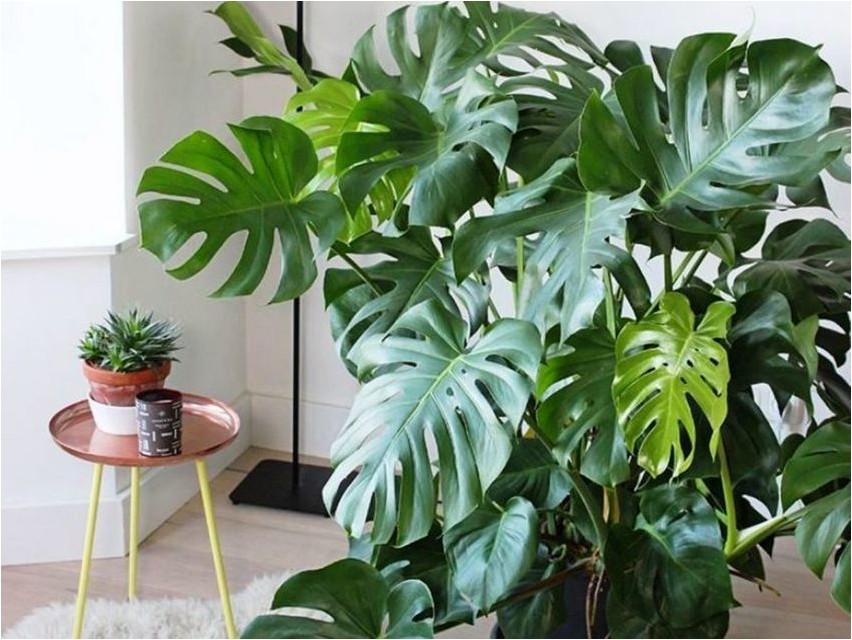
Monstera deliciosa (Latin: Monstera deliciosa) is a fruiting plant belonging to the Araceae family. Other names include the delightful or delicious monstera.
Description
Monstera deliciosa is a fast-growing, herbaceous vine capable of spreading over nearby trees to heights of up to nine meters or more. The stems of this plant are cylindrical, and their thickness can vary from 6. 25 to 7. 5 cm. All the stems are densely covered with deeply dissected leaves, and from below they sprout numerous aerial roots—stiff and quite long. The leaves boast a striking oval-heart shape and a leathery surface, and they are attached to the trunks by long, straight petioles. In some cases, the length of these leaves can reach ninety centimeters, but indoors, they usually do not exceed thirty centimeters.
Under particularly favorable conditions, this crop produces berry-like fruits that reach twenty to thirty centimeters in length and five to eight and a half centimeters in width. Each berry is covered with a fairly thick skin on top, and inside lies an incredibly aromatic and juicy pulp. The consistency of the pulp of ripe berries is very reminiscent of banana, and its flavor is reminiscent of a combination of banana and pineapple.
The first stage of ripening is easily identified—their scales begin to slowly lift, and the berries themselves acquire a rather strong aroma. However, they take a long time to fully ripen—until every single segment of the completely inedible skin falls off, revealing the juicy white pulp. Remarkably, these fruits can be eaten gradually, meaning ripe parts can be cut directly from the tree without interfering with the ripening of the remaining parts.
Where it grows
Monstera fasciatum originates from the subtropical and tropical forests of Panama, Mexico, Costa Rica, and Guatemala. In the nineteenth century, it was introduced to Southeast Asia, and today it is well known in almost every country as an ornamental greenhouse and indoor plant. However, in tropical countries, particularly India and Australia, it produces edible fruits, and it is for these that it is cultivated in these countries.
Uses

The attractive Monstera fruit is eaten fresh as a dessert. As for unripe fruits, they are very tasteless and are almost never eaten, since they contain quite a lot of oxalic acid salts, which can easily lead to irritation of the mucous membranes of the nose and mouth, followed by swelling.
The spectacular appearance of this plant allows it to be widely cultivated as a decorative plant — Monstera attractive is indeed one of the most beautiful deciduous plants, capable of decorating the interior of almost any room. That is why it is so highly valued by flower growers. This culture can often be found not only in residential, but also in industrial, domestic and a number of other premises, in the halls of cinemas, clubs and hotels, as well as in store windows and winter gardens. This beauty also looks great as a solitary plant, but its small specimens allow you to create luxurious compositions with other greenhouse or indoor crops.
Contraindications
When consuming Monstera, it is important not to forget that it contains substances that can irritate the mucous membranes and skin, and the juice of unripe berries can lead to inflammation of the oral mucosa or cause intestinal or gastric bleeding.
Monstera — My favorite. Home care