Beech
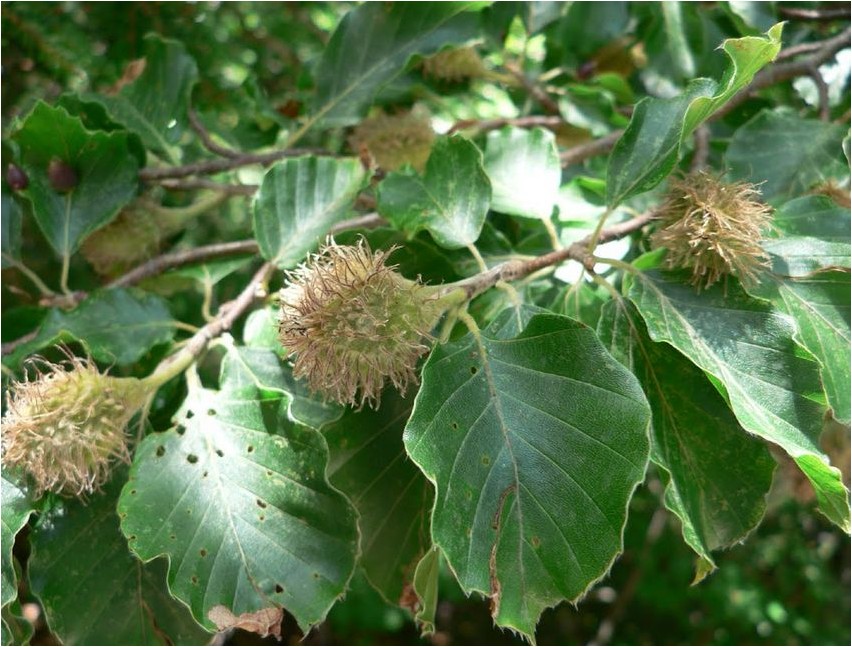
Beech (lat. Fagus) is a genus of slow-growing deciduous trees of the Beech family. They grow in North America, Asia and temperate Europe.
In nature, it is found in mixed and deciduous forests. Some beech species, which are now classified into other families, are distributed in New Zealand, Australia, New Guinea and South America. There are two species cultivated in Russia: forest beech and oriental beech.
Characteristics of culture
Beech is a tree up to 30 m high (there are specimens up to 50 m high) with a trunk covered with smooth gray bark and a dense crown. The leaves are entire or serrated, simple, oval-oblong or oblong, up to 15 cm long. The buds are scaly, elongated. The flowers are small, unisexual, wind-pollinated, collected in earrings. The fruits are triangular, acorn-shaped, covered with a woody shell. Beech begins to bear fruit only after 20-40 years, in some cases — after 60 years. The average age is 400 years.
Growing conditions
Beech is shade-tolerant and heat-loving, prefers well-lit areas, and easily tolerates partial shade. Soils are preferably loamy, fertile, moist, slightly acidic or alkaline. The culture has a negative attitude towards strong piercing winds. Beech is not drought-resistant; it loves moist air. The presence of lime in the soil is not prohibited. Beech is sensitive to salinity and pollution. Does not accept waterlogged, highly acidic and heavy clay soils.
Subtleties of reproduction and care
Beech is propagated by seeds, layering and stump shoots. The simplest and most effective way is propagation by layering of 3-4 years of age. Such cuttings quickly take root in a new place, but require regular watering and fertilizing. When separating cuttings from the mother plant, it is important not to harm the root system. It is advisable to plant beech seedlings individually or in biogroups.
The seeds of the crop are sown in the fall, but it is worth remembering that beech nuts attract rodents, so they need protection. Planting depth is 2-3 cm. When sowing in spring, preliminary stratification is necessary. After sowing, the ridges are mulched with dry leaves or sawdust in a layer of at least 2 cm. The plants are transplanted to a permanent place after 3-4 years. In the first year, seedlings are shaded.

Care consists of annual fertilizing with mineral fertilizers, watering during prolonged drought and loosening the soil in the tree trunk zone. Young plants need shelter for the winter. Mulching the tree trunk circle is encouraged; it is recommended to use organic materials as mulch. Sanitary and formative pruning is required; haircutting is not prohibited.
Application
Beech is a highly decorative plant, suitable for creating hedges and green walls. They look harmonious in combination with many deciduous and coniferous crops. Beeches are used as single and group plantings. Plants often appear in city parks, on the territory of sanatoriums, hospitals, children”s camps and holiday homes.
Beech wood is a valuable material; it is used to make musical instruments, parquet, gun stocks and other items. Beech chips are used in brewing. Wood is short-lived in the open air and is subject to deterioration and rotting.