Aki
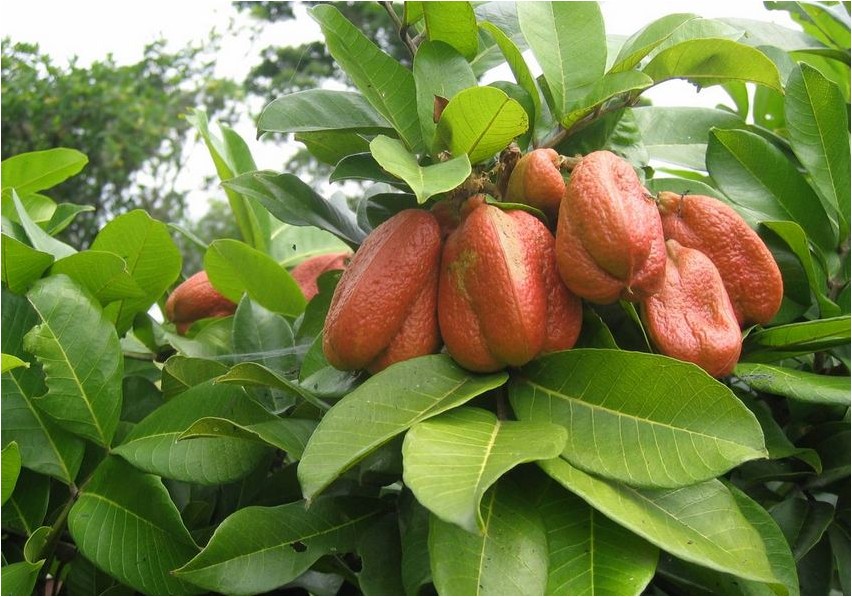
Ackee (Latin: Blighia sapida) is an exotic plant that is often called delicious Blighia.
Description
Aki is a very small tree, endowed with almost smooth grayish bark and reaching a height of ten to twelve meters. And the length of its elliptical leaves can vary from fifteen to thirty centimeters. Overall, ackee is a stunningly beautiful plant. Its small height is perfectly compensated by its surprisingly spreading crown, which allows it to be grown for decorative purposes.
Ackee fruits, colored orange or red-yellow, have some resemblance to a pear. As a rule, their weight ranges from one hundred to two hundred grams, and their length is about ten centimeters.
As for the botanical name ackee — delicious, it was received by the plant in honor of William Bligh, the famous English navigator, who simply adored taking with him seedlings or seeds of new and very unusual crops during his expeditions. And it was they who brought ackee fruits to Great Britain in 1793 — unusual fruits arrived there along with African slaves.
Where does it grow
You can try the wonderful ackee fruit in the distant and picturesque tropical zone — in Hawaii, in hot Brazil and in distant Jamaica, and its homeland is West Africa. It was from there that ackee was brought to Jamaica, and only then did this fruit begin to spread throughout Central America, as well as on the islands of the Bahamas and Antilles. However, single trees are sometimes found in Suriname and Colombia, as well as in Venezuela or Ecuador. At the same time, ackee is considered the “national fruit” only in Jamaica, and it is there that this fruit is most often eaten.
Application
Only ripe fruits can be eaten, since unripe specimens are poisonous. Determining the ripeness of ackee is not difficult — this is done by the degree of opening of the fruits: ripe fruits always burst, and their juicy creamy pulp, painted in calm beige tones, gradually peeks out. By the way, their taste resembles the taste of walnuts.

Ackee must be subjected to heat treatment — for this it is enough to boil the fruits for ten minutes. If this is not done, they will remain poisonous. It is noteworthy that it is precisely because of the toxicity of ackee that it is strictly forbidden not only to grow it in the United States, but also to import it from other countries. As for the calorie content of ackee, it is about 151 kcal for every 100 g.
Ackee makes an excellent side dish for fish, meat, or vegetables—the flavor is similar to the familiar fried egg. Ackee is also often served with baked breadfruit, an equally exotic fruit, as well as with pancakes or fritters.
Ackee is rich in oils and fatty acids (linoleic, stearic, and palmitic) that are very beneficial for the body. This fruit also contains numerous vitamins, including vitamins E, A, and B. It also contains fiber and protein.
In some West African countries, ackee is successfully used as a soap substitute (made from the peel and unripe fruit), and when crushed, it is widely used as a fish poison. The ground, dried seeds of this exotic fruit are an excellent remedy for fever. When combined with water, the crushed seeds are considered a highly effective antiparasitic agent. However, it”s not only the ackee seeds that are used to make medicines—the bark and dried leaves are equally popular. Jamaicans believe that such medicines can cure all ailments, including cancer. Cubans mix the pulp of ripe fruits with cinnamon and sugar—this is done to subsequently use them as an antidysenteric and antipyretic remedy.
Aki
https://www. youtube. com/watch? v=rPHNOySEY7E