Glaux
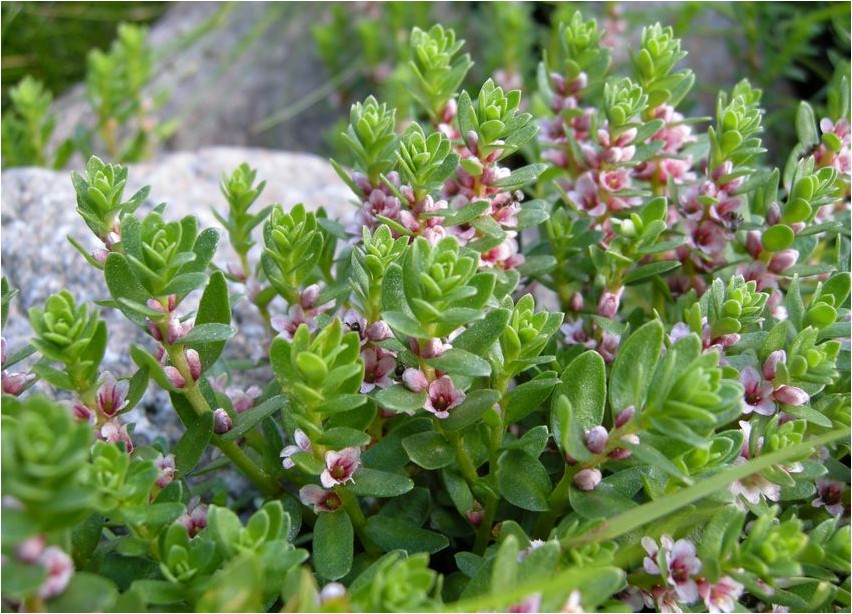
Glaux maritima (lat. Glaux maritima) is the only species of the genus Glaux (lat. Glaux), or Milky, classified by botanists in the family Primroses (lat. Primulaceae).
Later, botanists decided that this plant was still very close to plants of the genus Loosestrife (lat. Lysimachia), and therefore gave it a new name – “Lysimachia maritima”, however, leaving it as the only representative of the genus Glaux for one distinctive feature in the structure of the perianth.
What’s in your name
The official name of the genus “Glaux” dates back centuries. In written sources, it was first mentioned by the ancient Greek physician and naturalist, Pedanius Dioscorides, who collected a large number of recipes for medicines back in the 1st century AD, among which was one coastal medicinal plant, called a consonant ancient Greek word.
It is difficult to say whether it was this particular plant. For the first time this Latin name was combined with this plant at the beginning of the 18th century with the light hand of a French botanist named Joseph Pitton de Tournefort (1656 – 1708). It was later adopted as the official name of the plant by Carl Linnaeus when compiling the Classification of the Plant World.
The specific epithet “maritima” (seaside) is associated with the plant’s preference to live in coastal places, although in the wild Glaux can be found in many places in the subarctic and temperate zones of the Northern Hemisphere of the Earth, from which the seas are located quite far. On continents, it chooses moist soil, or grows in reservoirs.
Description
Glaux seaside is a herbaceous perennial plant that does not strive to stand out in height, and therefore its erect or ascending (this is when the stem is first parallel to the surface of the earth, and then suddenly decides to rush upward) stems do not exceed twenty-five centimeters in height. Rather, it can be called a creeping plant.

The guarantor of the longevity of Glaux primordiensis is a thin underground rhizome with side roots extending from it. From the rhizome to the surface of the earth, low stems, strong and juicy, are born.
On the stem, simple fleshy leaves with a smooth edge are located in friendly pairs. The leaves are small, their length does not exceed one and a half centimeters. The shape of the leaves can be different: linear, oblong-lanceolate, but more often they look like small children’s shovels with which children play in the sandbox. Sometimes the leaves are collected four to a node, forming a picturesque succulent whorl.
In the axils of the upper succulent leaves, resting on short pedicels, single miniature flowers are born. The structure of the perianth of Glaux maritima differs from plants of the genus Loosestrife (lat. Lysimachia) in the absence of a flower corolla. Apparently, this was the reason for botanists who identified the plant as an independent monotypic genus of the Primrose family. The white or pink corolla-shaped leaves are not the petals of a corolla, in the usual sense, but five colored sepals that form a flower calyx. Five stamens with ovoid anthers are attached to the base of the calyx. In the center of the entire flower arrangement, a thread-like pistil rises, showing the world a capitate stigma and an ovoid ovary.
The crown of the growing season is a spherical fruit-box, which, despite its small size (diameter up to three millimeters), consists of five nests. When fully ripe, the fruit disintegrates.
Usage
The herb Glaux maritum, collected during flowering, has healing abilities. It is not for nothing that one of the names of the plant is “Milkberry”, because an infusion from the plant’s herb is recommended for nursing mothers to take so that their milk is enough for a satisfying life for babies.
To do this, before meals you should drink fifty milliliters of dry herb infusion, prepared from one tablespoon of herb and a glass of boiling water and left to infuse for one hour.
The Indians of North America living on the coast consumed the cooked roots of the plant as food. This dish calmed the nervous system without provoking a craving for sleep.





