Sequence doubly pinnate
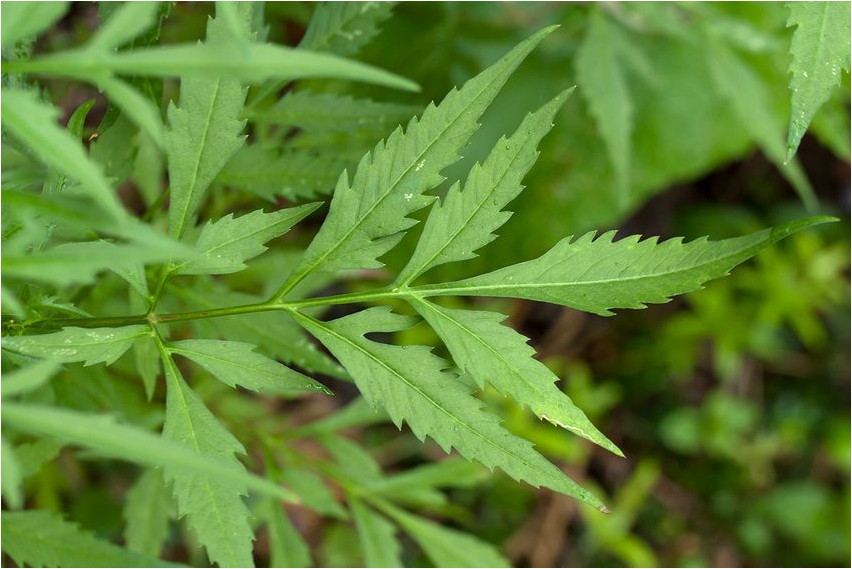
Double-pinnate series (lat. Bidens bipinnata) is one of the representatives of the plants of the genus Bidens (lat. Bidens), which has become widespread throughout the world.
The double-pinnate series is often called “Spanish needles” for the bizarre appearance of the seed head, and its double-pinnate leaves are successfully eaten by a number of animals, insects, and are also used for human food.
What’s in your name
Although the word “Bidens” in the name of this species is translated in the same way as in other species of plants of the genus Chereda, that is, “two” and “tooth”, this species is considered an eccentric among its relatives, often sporting its seeds ending in tridents. In addition, its seeds are slimmer and longer, and therefore the name “Spanish needles” is very suitable for the plant.
The described species owes the adjective “double-pinnate” to the shape of its leaves, which also differs from the shape of related plants, which are often covered with simple whole leaves. The leaves of the second order, while maintaining their integrity, are divided into smaller segments than is the case in other species of the genus.
Description
The underground part of the annual plant is represented by a tap root, from which numerous lateral roots extend.
An erect stem rises from the root to the surface of the earth, which may branch slightly. The surface of green or reddish-green stems is often bare, or almost bare.

The surface of the green leaves is smooth or slightly pubescent. The leaf blade may be double or triple pinnate, somewhat reminiscent of the leaf blades of a fern. The leaves of the second order are divided into lanceolate, oblanceolate or ovate lobes. The base of the leaf is wedge-shaped and the ends are blunt.
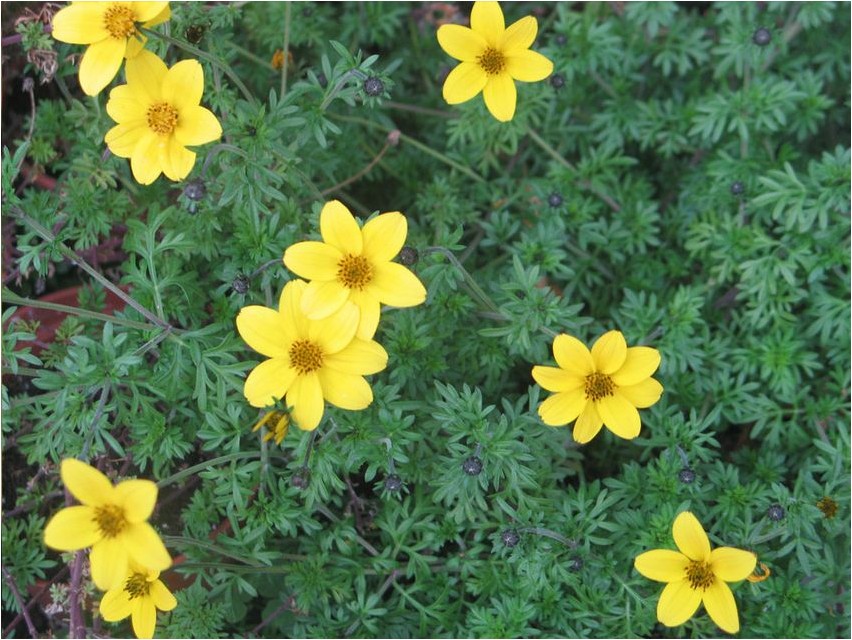
The upper stems end in long peduncles with single baskets of inflorescences. The central disk of the basket contains tubular flowers with golden-yellow corollas. Each corolla consists of five tiny lobes, similar to the lobes of a human ear. Around the disk there are rays of yellow petals, which may be absent on some baskets. The base of the flower head is surrounded by two-layered green bracts, of which the inner linear bracts are much longer than the outer ones.
In late summer or early fall, the flower heads transform into bizarre fruit clusters with long, slender, dark-brown seeds sticking out in all directions, like needles from a sewing pin. However, these needles end not in a single point, but in two or three, or even more, short awns (as botanists call them). Furthermore, these tiny awns have pointed beards, which the seeds use to cling to random travelers, such as passing animals, to find a new place to germinate, taking advantage of the free “transport” that comes their way. After all, the annual plant reproduces through self-seeding.
Cultivation
Bipinnate succulent can easily adapt to a wide range of environmental conditions. The plant’s size depends on soil fertility and moisture levels. Despite its tolerance, Bidens bipinnata prefers sites with filtered sunlight and fertile loam. In the wild, it is more common in drier places, growing in rocky clearings, wastelands, forest edges, and along riverbanks. The plant reproduces by seed or by self-seeding.
Pollen and flower nectar attract bees.
Many insects, their larvae, and caterpillars enjoy feeding on Bidens bipinnata leaves, causing damage to the plant. Aphids also attack Bidens bipinnata, sucking the sap from the flowering stems.
Uses
Bidipinnata bipinnata is a good honey plant.
Its leaves can add variety to rabbits’ diets.
Furthermore, the leaves and flowers are used in salads and added to soft drinks and alcoholic beverages.
The healing properties of Bidens bipinnata are also used in folk medicine.
Bidens bipinnata L.





