Common primrose
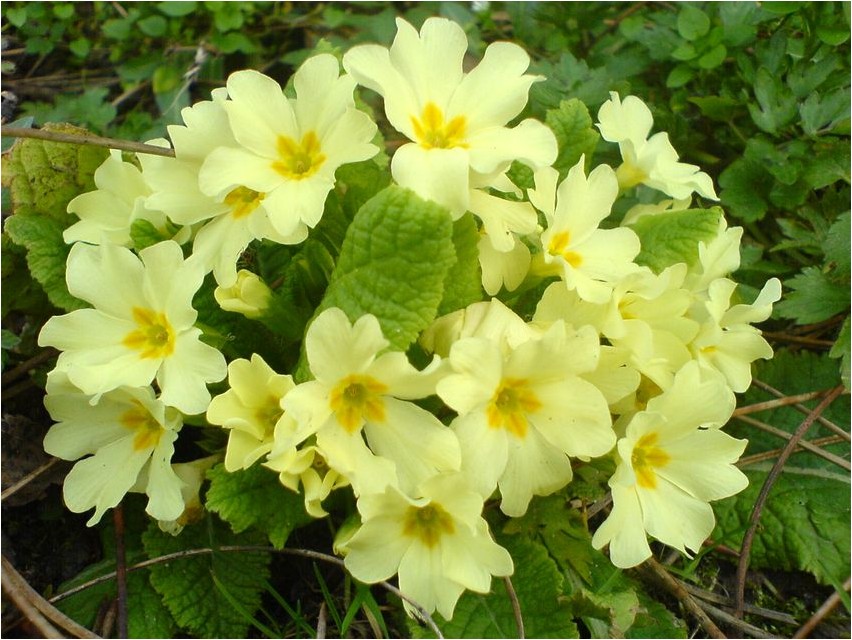
The common primrose is one of the plants of the family called primroses; in Latin the name of this plant will be as follows: Primula vulgaris Huds. (P. acaulis Jacq.).
As for the name of the common primrose family itself, in Latin it will be like this: Primulaceae Vent.
Description of the common primrose
The common primrose is a perennial herbaceous plant whose height can reach up to twenty-five meters. The rhizome of this plant is quite short and it will be endowed with brown colored roots. The length of the leaves of the common primrose will be about five to twenty-five centimeters, and the blade of such leaves will be obverse-lanceolate. At the top, the blade of such leaves is bare, and at the bottom it will be fibrous along the veins. The flower arrow of the common primrose will be undeveloped. The flowers of this plant are single, they are on pedicels, the length of which is approximately six to twenty centimeters; such flowers will emerge from the axils of the basal leaves. The calyx of this plant is divided into five lobes, and its length is one to two centimeters. The corolla of the common primrose is painted in light yellow tones and is endowed with a throat painted in pink, lilac, orange or violet tones. Such a corolla of this plant is endowed with a rather wide diameter, the length of which is about two to four centimeters. The fruit of the common primrose is somewhat shorter than the cups and is an egg-shaped capsule.
This plant blooms in early spring. Under natural conditions, the common primrose is found in Western Transcaucasia, Crimea, the Dnieper region and the Carpathians in Ukraine. For growth, this plant prefers alpine lawns near melting snow and deciduous forests.
Description of the medicinal properties of the common primrose
The common primrose is endowed with very valuable healing properties, and it is recommended to use the roots, leaves and grass of this plant for medicinal purposes. The concept of grass includes the leaves, flowers and stems of this plant.
The presence of such valuable medicinal properties can be attributed to the presence of carbohydrates, aromatic compounds, galactose, uronic acid, triterpenoids, glucose, primulagenin A, and 28-dehydroprimulagenin A in the roots of this plant. The leaves of this plant, in turn, contain quercetin, cyanidin, delphinidin, kaempferol, and triterpenoid glycoside, while the flowers contain flavonoids and essential oil.

Aqueous and alcoholic extracts of this plant are anti-inflammatory. Aqueous extracts of primrose leaves promote faster wound healing: this property has been confirmed experimentally. A decoction prepared from primrose roots is recommended for bronchopneumonia, bronchitis, and catarrh of the upper respiratory tract. An infusion of the leaves can be used as an antiscorbutic agent in cases of vitamin C deficiency.
The powdered leaves of this plant are used as a dusting agent for wounds. In folk medicine, primrose is quite widespread. An infusion made from the leaves and flowers of this plant is indicated for chronic constipation, bladder inflammation, migraines, and various colds. An infusion made from primrose flowers is recommended for insomnia, neurasthenia, and headaches. It should be noted that these remedies are quite effective.





