Podophyllum peltatum
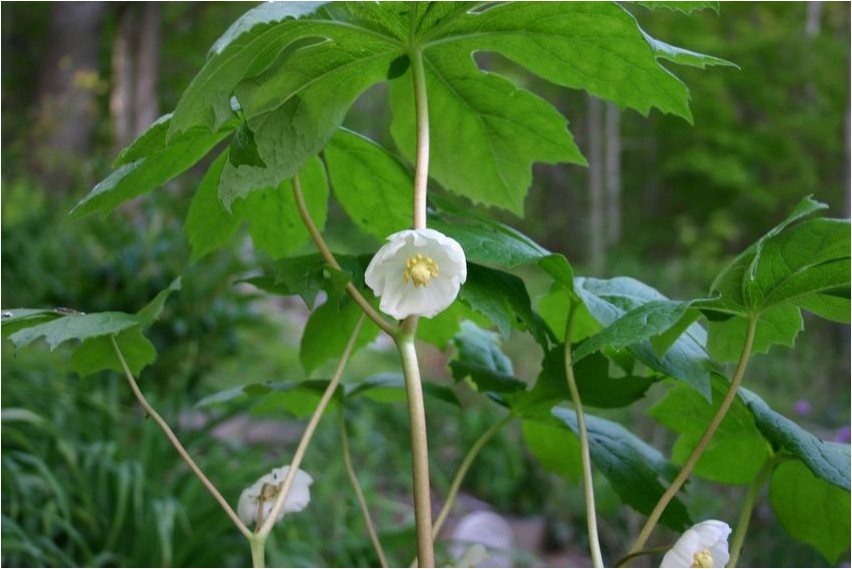
Podophyllum peltatum (Latin: Podophyllum peltatum) is a herbaceous perennial plant in the Berberidaceae family.
Description
Podophyllum peltatum is a plant with a nodular horizontal rhizome, reaching approximately one meter in length. Numerous adventitious rootlets extend from this rhizome, often reaching up to thirty-five centimeters in length. The stems of this plant range from thirty to forty centimeters in height, and the palmately dissected leaves range from twenty to thirty centimeters in length.
The white flowers, three to five centimeters in diameter, are equipped with elegant petals, numbering six to nine. These flowers develop in tiny leaf forks. Initially, they are characterized by an upright apical position, as if each floweret were supported by leaflets. After some time, the peduncles begin to bend, causing the flowers to bend downward, and the expanding leaves become terminal. Podophyllum peltatum usually blooms in May, more precisely in the second half, and the flowering period lasts on average three weeks.
Podophyllum peltatum fruits are yellow-green, ovoid, and fairly large berries, reaching two to eight centimeters in length and containing numerous tiny seeds and fleshy, aromatic pulp. The pulp is edible, but the seeds, leaves, and rhizomes are poisonous. The fruit has a sharp flavor, initially sweetish, and then slightly bitter. The fruit matures towards August.
Where it grows
Podophyllum peltatum originated in North America, specifically in its eastern part. In its native habitat, this plant grows primarily in shady and relatively damp forests.
Applications
The fruits of this plant are edible, but they should be consumed in moderation.

Podophyllum peltatum contains podophyllin, a resin containing various glycosides. Some of these glycosides are used medicinally, particularly for the treatment of genital warts, as well as laryngeal papillomas and bladder papillomatosis. Incidentally, it was recently discovered that podophyllin can inhibit the growth of malignant tumors.
The rhizomes and roots are considered the main medicinal raw material. They are usually harvested in the spring or fall, carefully washing each root to remove soil particles and thoroughly drying.
Podophyllum thyroid is an excellent helper for chronic inflammatory processes, but this culture is not particularly popular in folk medicine.
Contraindications
Podophyllum thyroid is contraindicated in pregnant women. As for the use of this plant in folk medicine, it is better to do this in strict accordance with the doctor’s instructions.
Sometimes the use of podophyllum thyroid can cause stomach upset, as well as nausea and vomiting.
Growing
Podophyll thyroid is an excellent garden ground cover ornamental plant. It grows especially actively in well-moistened, rich and loose soil. And in order for the plant to feel as comfortable as possible, it must be planted exclusively in the shade. If the thyroid podophyll grows in open areas, then in the second half of summer, when dry weather sets in, its pretty leaves may begin to dry out.
By the way, not only the conditions of the southern regions, but also the conditions of the Non-Black Earth Region are excellent for growing podophyllum thyroid. However, even under the most favorable conditions, this plant develops very slowly.





