Swallow swallow
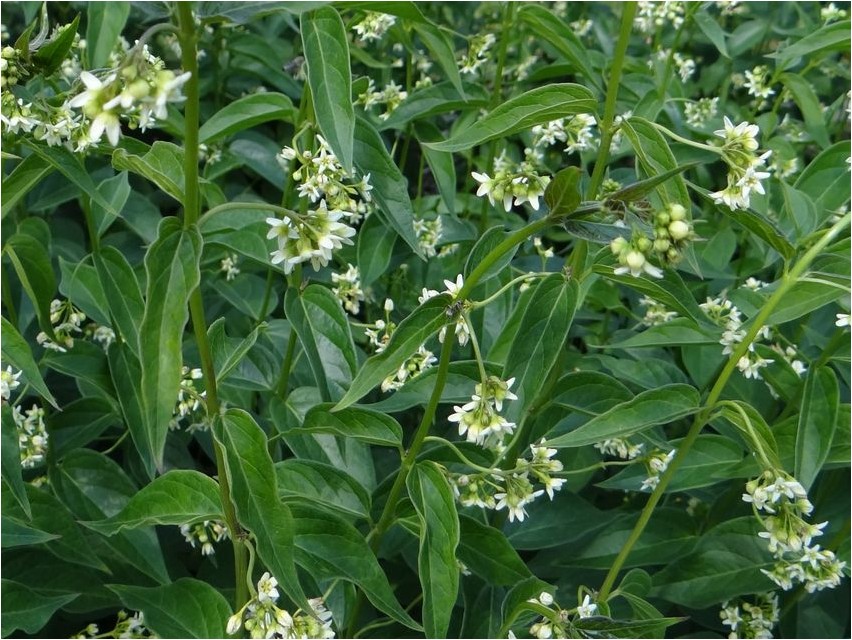
Swallow swallow is one of the plants of the family called swallowweed; in Latin the name of this plant will be as follows: Vincetoxicum hirundinaria Medic.
As for the name of the swallowtail family itself, in Latin it will be: Asclepiadaceae R. Br.
Description of swallowtail
Swallowtail is a perennial herbaceous plant. The stem of this plant will be approximately fifty to one hundred and twenty centimeters high, such a stem is simple and straight, and at the very top it will be weakly climbing, and also double-rowed. The leaves are ovate-lanceolate, their length is six to ten centimeters, and the width is about three to five centimeters. The lower leaves of this plant will be ovate, while the upper leaves are lanceolate. Umbrellas of the swallowtail are axillary and few-flowered, their width is one and a half to two millimeters, they can be either ovoid or oblong, or also obtuse. The crown of the stamens of this plant will be five-lobed, the leaflets are glabrous and lanceolate. The seeds of this plant are colored brown, they will be flattened and oblong-ovate in shape.
Flowering of the swallowtail occurs in the period starting from June and ending with the month of July, while the ripening of the fruits occurs in the month of August. Under natural conditions, this plant is found in the territory of Moldova, Ukraine, Belarus, as well as in regions of the European part of Russia, with the exception of only the Dvina-Pechora, Karelo-Murmansk, Lower Don, Black Sea and Lower Volga regions. For growth, this plant prefers places along the banks of rivers and seas, bushes and forests. It is noteworthy that this plant is not only a very valuable honey plant, but also an ornamental crop.
Description of the medicinal properties of swallowtail
The swallowtail is endowed with very valuable healing properties, and it is recommended to use the rhizome, seeds and leaves of this plant for medicinal purposes. It is important to note that the chemical composition of this plant has not yet been fully studied.
It is noteworthy that the tincture of the rhizomes of this plant is endowed with the ability to exhibit antifungal activity. An infusion prepared from the rhizomes of the swallowtail is recommended for use as a valuable diuretic for ascites and various kidney diseases. In addition, this healing agent is also used as an emetic and laxative, and is also used for malaria and amenorrhea. An infusion and decoction of rhizomes, seeds and leaves of this plant is recommended for use in diabetes mellitus. It is noteworthy that such products based on swallowtail are endowed with a foxglove-like effect. An infusion and decoction prepared from the rhizomes of this plant can be used externally for snake bites and as a wound healing agent. A decoction of the seeds of this plant, in turn, can be used as a pain reliever.

The following remedy based on swallowtail is used as a diuretic: to prepare such a remedy you will need to take one teaspoon of crushed rhizomes of this plant in two cups of boiling water. The resulting mixture should be infused for one hour, and then this healing mixture based on this plant should be filtered very carefully. Take the resulting medicine based on swallowtail three times a day, one third of a glass. It should be noted that it is very important to carefully follow all the rules for taking and preparing such a product.
Lastoven officinalis
https://www. youtube. com/watch? v=cYL2Bf3SX6s