Pueraria lobe
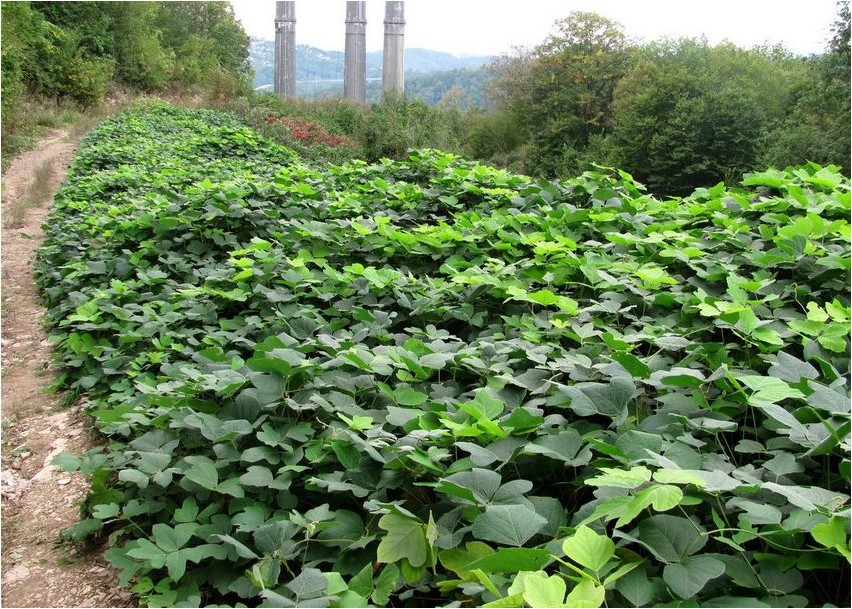
Pueraria lobata is one of the plants of the family called legumes; in Latin the name of this plant will be as follows: Pueraria lobata (Willd.) Ohwi. (P. hirsuta (Thunb.) Matsum., P. thunbergiana (Bieb. et Zucc) Benth.
As for the name of the Pueraria lobed family itself, in Latin it will be: Fabaceae Lindl. (Leguminosae Juss.).
Description of Pueraria lobe
Pueraria lobata is a large perennial vine, endowed with woody, pubescent, semi-recumbent or climbing stems, the diameter of which is about ten to twelve centimeters. In addition, such a plant will be endowed with almost horizontal powerful roots, the length of which is approximately two to three centimeters, and their diameter will be similar to the diameter of the stems. The leaves of Pueraria lobe are very large and trifoliate. The flower clusters in the very axils of the leaves will be multi-flowered, their length varies between twelve and twenty centimeters, and sometimes this figure can reach thirty centimeters. Pueraria lobe flowers are on fairly short stalks; they will be quite large and easily fall off, and their length is one and a half to two and a half centimeters.
Description of the medicinal properties of Pueraria lobe
Pueraria lobe is endowed with very valuable healing properties, and it is recommended to use the roots and grass of this plant for medicinal purposes. The term grass includes flowers, stems and leaves.
The presence of such valuable healing properties is recommended to be explained by the content of starch, carbohydrates diadzein and diadzin in the rhizomes of this plant. The leaves contain flavonoids, including the isoflavone pcerarin; the buds and leaves will contain asparagus, the flavonoid robinin, adenine, glutamic and butyric acid.
An infusion or decoction prepared from dried roots and flowers has become quite widespread in folk medicine. Here, such healing agents are used as anti-cold, diaphoretic and anti-fever agents.

The roots of Pueraria lobe are indicated for use as an expectorant for coughs, and are also used for various diseases that will be accompanied by headaches and fever. The flowers of this plant are used as a hemostatic and thirst-quencher; in addition, they are used for malignant tumors and enterocolitis. Pueraria lobata leaves are used as an antiemetic, and such medicinal elements are also used for headaches that arise due to hypertension. Also, the roots of this plant are used as antiemetics and are used as antidotes for the bites of various poisonous insects and snakes.
The roots of this plant are used not only for colds, but also for numerous diseases that will be accompanied by an increase in temperature, including pneumonia, measles, bronchitis and scarlet fever. Such remedies are effective for vomiting, diabetes, tonsillitis, inflammation of the small and large intestines, and as part of the preparations this plant is used for endemic goiter.
When children have fever and thirst, it is recommended to use the juice of this plant: this will require approximately four liters of Pueraria lobe juice, divided into three parts and used regardless of meals. You can also brew nineteen grams of the root of this plant in water and drink this decoction throughout the day. Such medicinal remedies based on Pueraria lobata prove to be very effective.