Eustoma
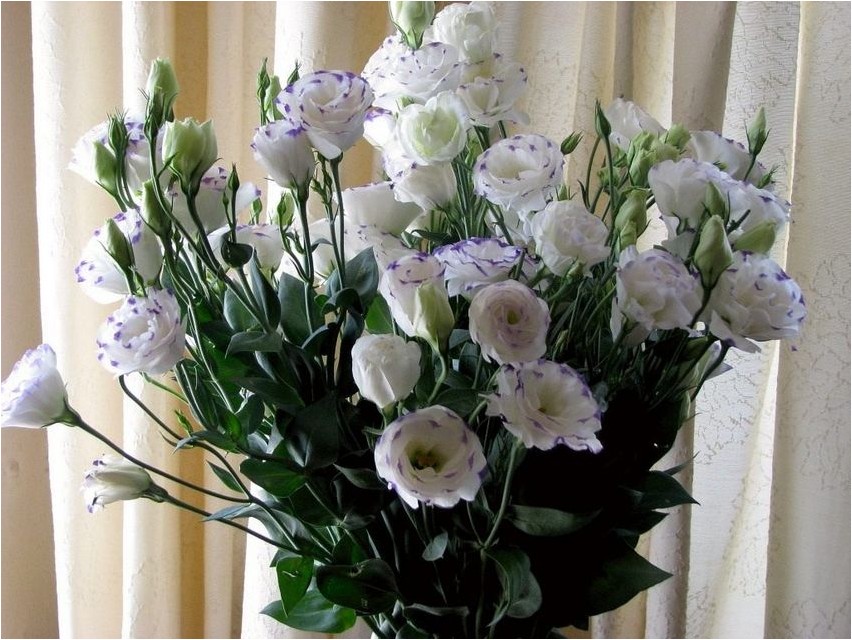
Eustoma (lat. Eustoma) is a genus of annual and perennial plants of the Gentian family. The second name is Lisianthus (lat. Lisianthus).
It grows naturally in the southern United States, Mexico, the Isthmus of Panama and some islands of the Caribbean. In Russia, Eustoma grandiflora has become widespread and is grown as a houseplant or ornamental plant.
Characteristics of culture
Eustoma is a herbaceous plant with erect, densely leafy stems 45-60 cm high. The leaves are sessile, light green, ovate or lanceolate. The flowers are bell-shaped, solitary, and can be white, pink, lilac, purple, blue, light yellow and apricot. Depending on the variety, they can be double or simple; there are bordered and two-color forms.
Relevant among gardeners is Eustoma Russell (lat. Eustoma russellianus). The plant is a shrub with straight branched stems and oval leaves of a grayish-green color. The flowers are quite large, bell-shaped, and can be of a wide variety of shapes and colors.
Growing conditions

Eustoma prefers well-lit rooms with a small amount of direct rays within 24 hours. In winter, plants need additional lighting using fluorescent lamps. The soil for eustoma requires loose soil with a pH of 6. 6-7. 0, rich in microelements.
The optimal growing temperature in spring and summer is 20-25C, in autumn and winter – 12-15C. Eustoma has a negative attitude towards high air humidity, reacts negatively to spraying, and is often affected by fungal diseases from this procedure.
Reproduction, planting, transplanting
Eustoma is propagated by seeds and by dividing the bush. Seeds are sown in early spring in low containers filled with sterilized soil substrate. The crops are covered with glass or plastic film and kept at a temperature of 23-25C until germination.
Periodically the cover is removed for ventilation. Watering is carried out using a spray bottle. As a rule, shoots appear in 10-15 days. When the seedlings have two pairs of true leaves, they are planted in separate pots. Plants bloom a year after planting.
Vegetative propagation is carried out using cuttings; they are planted in wide and low containers, at the bottom of which a layer of expanded clay and soil substrate are poured. When the divisions take root, they are transplanted into separate pots.
Care
Eustoma needs regular and abundant watering; drying out and waterlogging should not be allowed. In winter, the amount of watering is reduced. Fertilizing is carried out during the period of active growth twice a month; complex mineral fertilizers are ideal for this purpose.
It is necessary to promptly remove faded stems of the plant, leaving at least two pairs of leaves. Due to the fact that eustoma is often affected by thrips, spider mites and whiteflies, plants require preventive treatments against pests.