Perilla
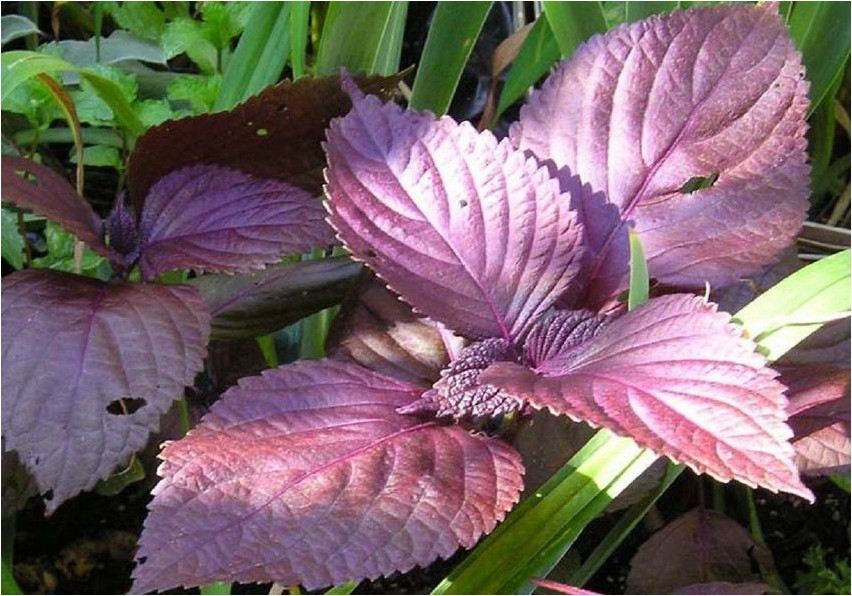
Perilla (lat. Perilla) is a monotypic genus of annual plants of the Lamiaceae family. Other names are shiso, suza or Japanese parsley.
Japan is considered to be the birthplace of the plant, although some agronomists claim that perilla came to us from China. Since ancient times, large perilla plantations have been located in both countries. In Russia, the crop began to be cultivated relatively recently, first in the Far East, then in Siberia, the Urals and the European part of the country. The plant came to the USA and Canada only at the end of the 19th century, where it quickly spread and became a common weed in some areas.
Characteristics of culture
Perilla is a herbaceous, highly branched plant up to 1 m high, with a straight tetrahedral ascending stem. The leaves are curly or wrinkled, with slightly toothed or strongly toothed edges, arranged oppositely. The lower leaves are quite large, ovate, long-petiolate, the upper leaves are slightly oblong, short-petiolate or almost sessile. Depending on the variety, the leaves can be dark purple, violet, soft green, violet-burgundy, black or red, and bicolor perillas are also found.
The flowers are axillary, collected in racemes or paniculate inflorescences, sitting on short hairy pedicels. Bracts linear-lanceolate, pubescent. The calyx is goblet-shaped or bell-shaped, two-lipped. The corolla is vaguely two-lipped. The fruit is a dry multi-nut, split into four round parts with a mesh surface. The seeds are brown or light orange, small. All parts of the plant have a distinct aroma of peppery basil and refreshing lemon balm.
Growing conditions
It is advisable to grow perilla on loose, moderately moist, alkaline or slightly acidic soils with a high content of nutrients. The culture does not accept sandy, heavy clay, swampy and saline soils. The location is preferably sunny or with light openwork shade. Solid shadow will negatively affect the development of plants; it will not be possible to get a good harvest of grass in such an area.
Sowing
In Russia, perilla is grown to produce tender greens, and not to produce seeds, so the seedling method is most often used. This is necessary in order to speed up the process of the appearance of healthy and tasty leaves. The seeds of the crop germinate very slowly; before sowing, they must be soaked in warm water for 48 hours, and the water must be changed every 8-10 hours.

After treatment, the seeds are dried and sown in seedling trays filled with fertile soil mixed with peat and humus. Sow the seeds densely, then select the strongest specimens and plant them in a greenhouse or in the ground under plastic. Space plants at least 20-30 cm apart. Perilla can be grown as an ornamental plant; they are suitable for creating a backdrop for flower beds and for border plantings.
Care
Perilla care is relatively straightforward. It involves regular weeding, watering, fertilizing, and loosening the spaces between rows. Liquid mineral fertilizers can be used for fertilizing; apply them after each cutting. Perilla is resistant to diseases and pests, so preventative treatments are not necessary.
Harvesting and Storage
The first cutting is done in mid-summer, before flowering. Shoots with leaves are pruned at a height of 10-12 cm from the soil surface. Two to three cuttings are typically made per season. The yield of the crop depends largely on climate conditions and careful care; typically, 0. 5-5 kg is harvested per square meter of planting. Fresh greens can be stored for 7-10 days. Avoid using plastic bags; glass or plastic containers with small holes are preferred.
Applications
Perilla is primarily valued as an oilseed, as its seeds contain approximately 40-45% oil, which is used to produce drying oils, varnishes, printing inks, and waterproof fabrics. In some Asian countries, perilla oil is used for medicinal purposes. Perilla is also widely used in cooking; its leaves and stems are added as a spice to a wide variety of dishes. Perilla is a favorite among herbal herbs. With this aromatic antiseptic, even the coronavirus isn’t so scary.





