Oxytropis soft-needle-leaved
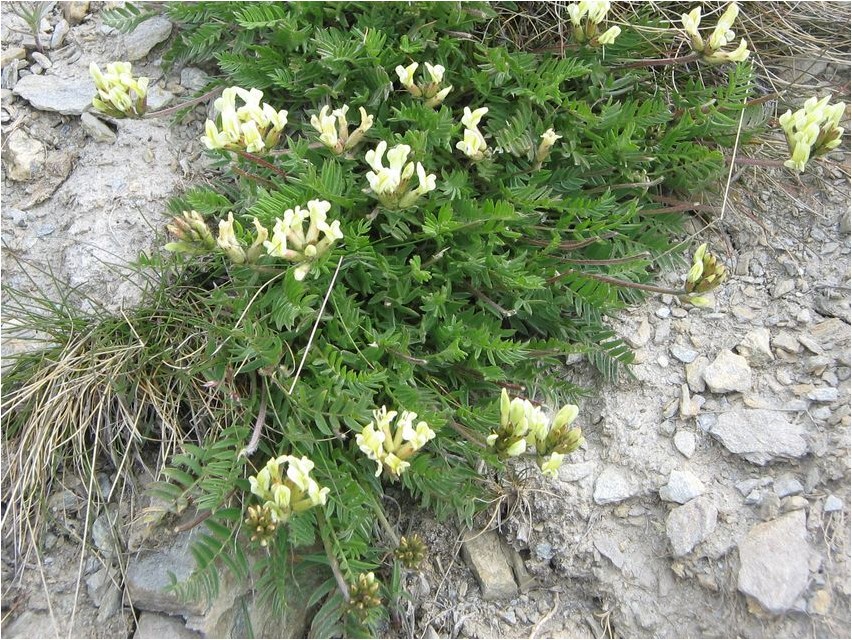
Oxytropis soft-needle-leaved is a member of the legume family. Its Latin name is Oxytropis muricata (Pall.) DC.
The Latin name of the Oxytropis soft-needle-leaved family is Fabaceae Lindl. (Leguminosae Juss.).
Description of Oxytropis soft-needle-leaved
Oxytropis soft-needle-leaved is a perennial stemless plant with a peduncle about ten centimeters tall. The root is two centimeters thick and multi-headed, bearing numerous shortened stem shoots. These shoots, in turn, bear large leaves and flower stalks. The leaves of Oxytropis soft-needle are approximately ten to twenty centimeters long, green in color, and covered with glandular hairs. The leaflets of this plant are linear, arranged in clusters of four, and the total whorls of Oxytropis soft-needle are approximately eighteen to twenty-five. The flower stalks of this plant are erect, the flowers in the heads can sometimes be elongated, while the corolla is colored a dirty yellow. The standard is approximately twenty-two to twenty-three millimeters long and seven millimeters wide. The length of the wings including the blade is approximately seventeen millimeters, with the keel equal to the wings, and the beak is approximately one millimeter long. The pod of this plant is oblong-lanceolate. Oxytropis soft-needle flower blooms in July. In terms of general distribution, this plant can be found in northern Mongolia. In the wild, it grows in Western Siberia, as well as in the Daurian and Angara-Sayan regions of Eastern Siberia. Oxytropis soft-spinedum prefers the banks of saline rivers, steppes, and sandy and rocky-salty slopes.
Description of the medicinal properties of Oxytropis soft-spinedum
Oxytropis soft-spinedum has very valuable medicinal properties, and the roots and herb of this plant are recommended for medicinal purposes. The herb includes the leaves, flowers, and stems of this plant.
The presence of such valuable medicinal properties is believed to be explained by the plant’s content of essential oil, carbohydrates, tannins, flavonoids, the alkaloid muricatinine, and muricatin. Remarkably, experimental studies have shown that preparations based on this plant have a calming effect on reflex activity and the central nervous system, and can also have a depressant effect depending on the dose. Dry extracts and decoctions of this plant have a choleretic effect.
Decoctions and infusions of Oxytropis soft-needle herb are quite widespread in Tibetan medicine. Here, such remedies are used as wound-healing, choleretic, anthelmintic, and sedatives and depressants of the central nervous system. Furthermore, remedies based on this plant are used for poisoning, various parasitic skin diseases, and infectious diseases. A decoction based on the roots of Oxytropis aquifolium is recommended in Tibetan medicine as a wound-healing and hemostatic agent, while a decoction based on the herb of this plant is indicated for use in various gynecological conditions.

AQUARIUM CARE





