Water Nut
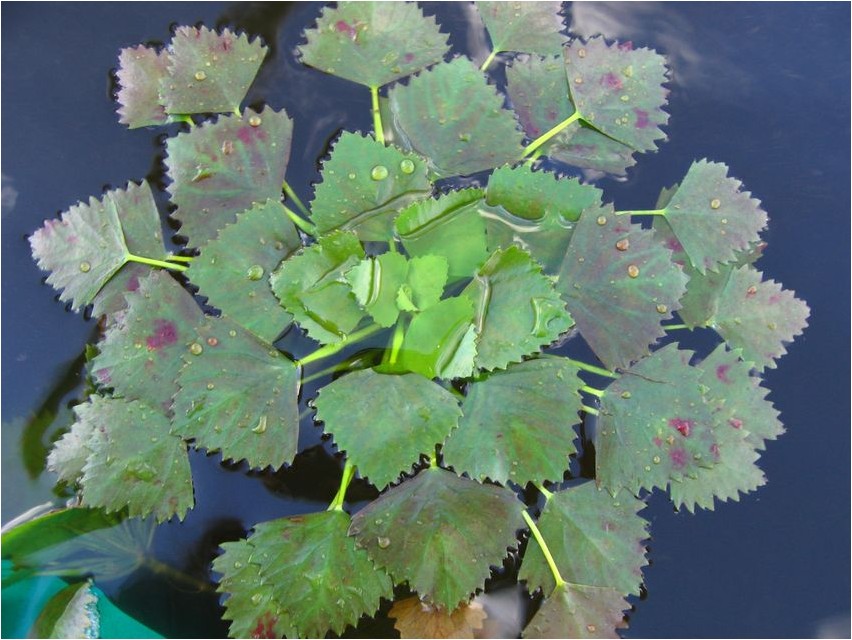
The water nut is a member of the water chestnut family. Its Latin name is Trapa natans L.
The family name of the water nut itself is Trapaceae Dumort. (Hydrocaryaceae Raimann).
Description of the Water Nut
The water nut is an annual aquatic plant. The petioles of its floating leaves are approximately ten centimeters long, either bare or pubescent, and are equipped with oblong-elliptical floating bladders. The leaf blades of the water nut are approximately one to three centimeters long and unequally toothed. The nut has a conical base and four paired, opposite, powerful horns. The neck is approximately five millimeters high, and the crown diameter is six to ten millimeters, although the crown may sometimes be almost absent. At the base of the fruit, the inner diameter of the ring of the water nut is approximately two to two and a half millimeters.
In the wild, this plant is found in Eastern Siberia, Belarus, the Dnieper region of Ukraine, and the Volga-Don region of European Russia. Generally, it is found in Asia Minor, the Mediterranean, Central and Atlantic Europe, as well as Macedonia and Montenegro in the Balkans. The water nut prefers oxbow lakes, river backwaters, and the calm waters of lakes and rivers.
Description of the medicinal properties of the water nut
The water nut has very valuable medicinal properties, and its seeds are recommended for medicinal purposes. The presence of such valuable medicinal properties is believed to be attributed to the starch and carbohydrate content of the seeds of this plant.
Notably, water nuts play a very effective role in combating malarial mosquitoes. In folk medicine, this plant is widely used. Traditional medicine uses a decoction made from water nuts seeds for rabies, diarrhea, dysentery, and poisonous snake bites. An alcohol infusion made from the seeds has been shown to inhibit the growth of Ehrlich’s ascites tumor.

The seeds of this plant are perfectly acceptable to eat, either baked, boiled, raw or fried. In addition, milky waterfloat seeds can be used as a flour substitute for making porridge, while roasted milky seeds are used as a coffee substitute. In addition, the seeds of this plant are used as food for beavers, wild boars, pigs, waterfowl, nutria, and dairy cattle. For this use, water nut seeds should be used in the form of briquettes, granules and flour.
For dysentery, it is recommended to use the following very valuable remedy based on this plant: to prepare such a healing remedy, you will need to take twenty grams of crushed water nut seeds per glass of water. It is recommended to boil the resulting healing mixture for about five to six minutes, then leave this mixture to infuse for two hours, after which this mixture is filtered very carefully. Take the resulting healing remedy based on water nut three to four times a day, one-third of a glass before meals. When used correctly, this healing remedy will be very effective.





