Cunninghamia
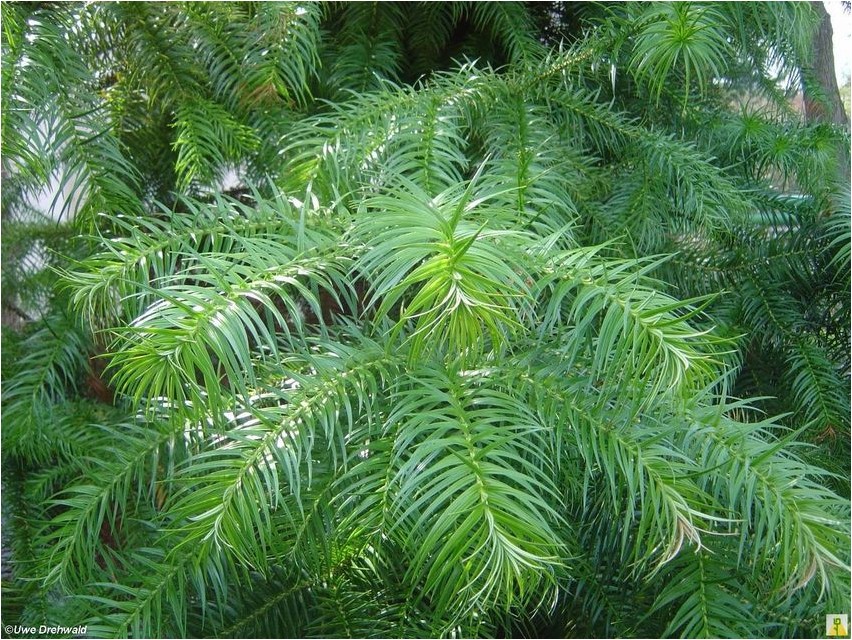
Cunninghamia (Latin: Cunninghamia) is a genus of evergreen trees in the Cupressaceae family. The genus was previously classified in the Taxodiaceae family. Today, the genus includes only two species, but most botanists consider them subspecies of Cunninghamia lanceolata.
The genus was named in honor of two naturalists and botanists, James and Allan Cunningham. Its native range is Taiwan and the montane rainforests of northern Vietnam, southern and central China.
Cultural Characteristics
Cunninghamia is a coniferous tree up to 50 m tall with a pyramidal crown. The trunk is covered with gray-brown bark that peels off in long strips. The branches are drooping. The needles (modified leaves) are light green or dark green, linear-lanceolate, pointed, sickle-shaped, leathery, finely serrated along the margins, with a wide base, up to 7 cm long, and arranged in two rows on the shoots.
The cones are oval or spherical, reaching 2-2. 5 cm in diameter, covered with imbricated scales that curve at the ends. The seeds are compressed, yellowish-brown, and narrowly winged. The wood of the Cunninghamia is light, soft, has a reddish tint, and a pleasant aroma. It is often used to make paper, essential oils, and various handicrafts. Cunninghamia is not known for its winter hardiness. Cunninghamia lanceolata can withstand temperatures down t o-17. 5°C, while Cunninghamia konishi can withstand temperatures down t o-6. 5°C. Growing Conditions
Cunninghamia prefers well-moistened, slightly acidic, clayey, or sandy soils. It does not tolerate waterlogged, saline, calcareous, or alkaline soils. A sunny location is preferable; light shade will not harm the plants. Cunninghamia is quite demanding in terms of air humidity, so in Russia it is grown only on the Black Sea coast. Cunninghamia lanceolata is a frequent guest in greenhouses and winter gardens.
Propagation Tips
Cunninghamia is propagated by seeds, cuttings, and root suckers. Sow freshly harvested seeds in February in heated greenhouses. Do not store the seeds, as they quickly lose viability. Seedlings typically appear within 40-60 days. The optimal temperature for seed germination is 18-20°C. Stored seeds are soaked in warm water for 3-4 hours before sowing, then stratified for 1 month. Scarification of cunninghamia seeds is recommended.
Cunningamia is often propagated by root shoots, less often by shoots that form in the lower part of the trunk. Cuttings are not prohibited. Cuttings are cut from semi-lignified shoots. Each cutting must have a “heel”. To obtain plants with a beautiful pyramidal crown, cuttings are taken from vertical shoots, and creeping forms — from lateral shoots.

Growing cunningamia at home
When growing cunningamia as an indoor crop, it is important to maintain optimal conditions. In the summer, plants need increased air humidity. Regular watering and spraying is a prerequisite for proper maintenance of cunningamia.
With the onset of cold weather, watering plants is significantly reduced. The room temperature in winter should not exceed 20C. In the spring, cunningamia is fed with long-acting fertilizers designed specifically for coniferous crops.
Cunningamia