Clerodendrum
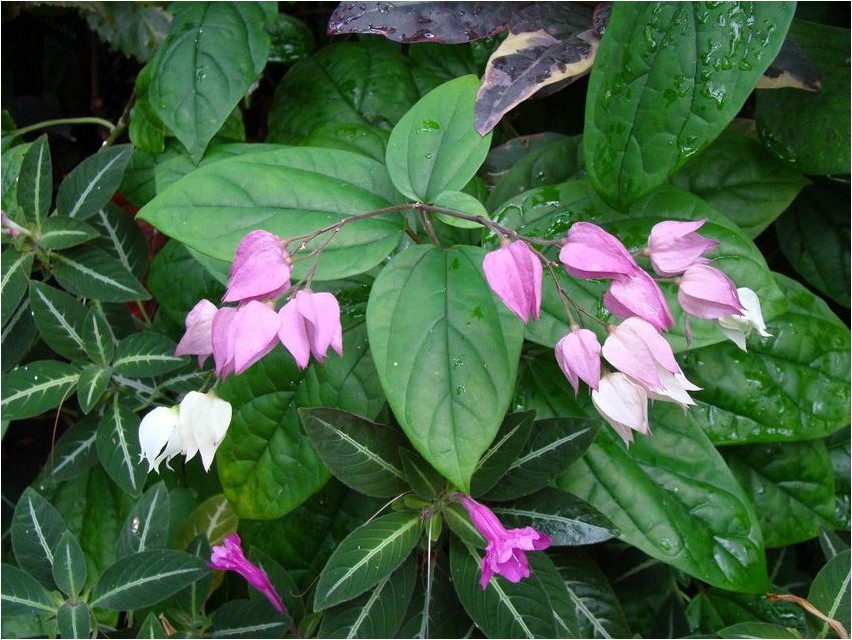
Clerodendrum (lat. Clerodendrum) is a genus of evergreen and deciduous shrubs, trees and climbing vines of the Verbenaceae family. The natural range is the tropical regions of Asia, Africa and South America.
The plant is often called volkameria (lat. Volkameria). Also known are the popular names — innocent love and tree of fate.
Common types and their characteristics
*Thomson”s clerodendrum (lat. Clerodendrum thomsoniae) — the species is represented by climbing woody vines with thin, smooth, fast-growing shoots. The leaves are bare, entire, pointed, oblong-ovate. The flowers are white-red, collected in axillary, loose paniculate inflorescences. Thomson”s clerodendrum blooms in March-June, often re-blooming closer to autumn. In warm regions, flower panicles may bloom throughout the winter.
*Clerodendrum most beautiful (lat. Clerodendrum speciosissimum) — the species is represented by evergreen shrubs up to 3 m high. The shoots are tetrahedral. The leaves are large, heart-shaped, opposite, soft, covered with short hairs over the entire surface. The flowers are dark red, collected in apical paniculate inflorescences. The most beautiful clerodendrum blooms in June-September.
* Fragrant clerodendrum (lat. Clerodendrum fragrans) — the species is represented by evergreen shrubs 1-2 m high. The shoots are pubescent, numerous. The leaves are heart-shaped or broadly ovate, pubescent, deeply serrated along the edges, up to 20 cm long. The flowers are white inside and pinkish outside, collected in dense apical corymbose inflorescences, and have a pleasant, pronounced aroma. Blooms all year round with short breaks. Varieties with double flowers are known.
*Ugandan clerodendrum (lat. Clerodendrum ugandense) — the species is represented by liana-like shrubs. The popular name is Blue Butterfly, which is directly related to the shape of the flowers. The leaves are dark green, narrowly obovate or broadly lanceolate, up to 10 cm long. The flowers are lilac or blue, collected in loose, few-flowered inflorescences. In appearance, the flowers are similar to butterflies. Ugandan clerodendrum is characterized by rapid growth; in a couple of months it can form a tall bush up to 3 m high.

* Philippine clerodendrum (lat. Clerodendrum philippinum) — the species is represented by evergreen shrubs that have a strong pleasant aroma, reminiscent of the smell of the well-known jasmine. The aroma is known to intensify in the evening and at night. The leaves are dark green, wide, velvety. The flowers are white-pink, collected in corymbose inflorescences up to 20 cm long.
Growing conditions
Clerodendrum is photophilous and develops well in intensely lit areas with shading from direct sunlight. When growing indoors, the best option would be western and eastern windows. Soils are preferably loose, drained, fertile, slightly acidic. It is not recommended to grow clerodendrum on saline, compacted, waterlogged and highly acidic soils. The crop is sensitive to drought and needs regular spraying, especially when grown indoors with low air humidity.
Subtleties of propagation and planting
Clerodendrums are propagated by seeds and cuttings. All species have their own subtleties of reproduction. For example, the most beautiful clerodendrum is propagated by cuttings from January to March, and in a removable way — in February-March. The seeds are sown in separate containers with a diameter of 6-7 cm. The substrate is made up of sand, turf and humus soil in the ratio (1: 1: 1). The optimal room temperature is 18-20C. Clerodendrums propagated by seeds bloom in the same year.
Cuttings of the crop are rooted in water or in a substrate prepared as for sowing seeds. Clerodendrum philippines is propagated not only by seeds and cuttings, but also by root cuttings, and clerodendrum fragrant is propagated by root segments. Thomson”s clerodendrum is most often propagated by semi-lignified cuttings, which are cut in the spring. They are planted in containers filled with sand or peat chips, laid in layers.
Care
Watering abundantly using soft warm water. The earthen clod should not be allowed to dry out. In the winter season, watering indoor specimens is rare. Clerodendrums are fertilized from April to August. When leaf chlorosis is detected, iron-containing preparations are applied to the tree trunk zone. Sanitary and formative pruning is carried out in the spring. The trimmings for each species are not the same.





