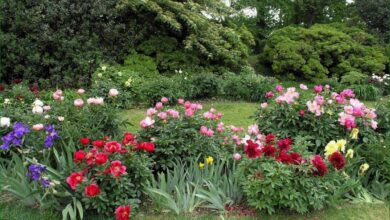
Diervilla

Diervilla (lat. Diervilla) is a genus of flowering plants of the Dierville subfamily of the Honeysuckle family. The genus contains only three species naturally occurring in North America.
The genus received its name in honor of the French surgeon Marin Dierville.
Common types and their characteristics
* Diervilla sessilifolia (lat. Diervilla sessilifolia) — the species is represented by densely branched shrubs up to 2 m high with characteristic tetrahedral shoots. The leaves are short-petiolate, elongated-ovate, with jagged edges and an extended tip. The flowers are yellow, small, collected in umbrella-shaped inflorescences. The fruits are woody capsules. The seeds are small, ovoid. Diervilla sessile leaves bloom in July-August, the fruits ripen in September-October.
*Diervilla rivularis (lat. Diervilla rivularis) — the species is represented by shrubs up to 2 m high with rounded, densely pubescent shoots. The leaves are short-petiolate, oval-lanceolate, up to 8 cm long. The flowers are yellow, collected in multi-flowered panicles. Diervilla brook blooms in July — August. Some varieties of the species are highly decorative.
*Diervilla honeysuckle (lat. Diervilla lonicera) — the species is represented by shrubs up to 2 m high with large oval-oblong leaves. The flowers are yellow, collected in few-flowered inflorescences. The petals of the corolla are narrow, bent upward. The fruit is a capsule narrowed towards the top.
Growing conditions
Dervilla is moisture-loving. It is undemanding to soil conditions and accepts almost any soil. Prefers partial shade to open sunny areas. Diervilla can be grown under the canopy of trees with an openwork crown.

Reproduction
Diervilla is propagated by seeds, cuttings, layering and root suckers. The simplest and at the same time effective way is propagation by root suckers, which are formed in large numbers annually. In the spring, the offspring are separated from the mother plant and transplanted to a permanent place.
Reproduction by layering is also encouraged. Getting planting material is not at all difficult. To do this, the lower shoots are placed in grooves, covered and watered regularly. The following spring, the rooted cuttings are separated from the mother plant using a shovel and transplanted to a new location.
The seed method is quite labor-intensive and time-consuming. Sowing is carried out in the spring. To speed up seed germination, a three-month stratification is carried out. Diervilla seedlings are transplanted to a permanent location after 2 years.
Landing
It is recommended to plant diervilla in the spring. Planting holes are prepared at least two weeks before the intended planting. The depth of the hole should be about 40-50 cm, diameter — 40-45 cm. At the bottom of the hole, a slide is formed from fertile soil mixed with sand and humus in equal proportions.
Before planting, the roots of seedlings are shortened using pruning shears. After planting, abundant watering and mulching of the tree trunk area is carried out. For mulching, you can use both organic and artificial material.
Care
Standard care: watering, weeding and loosening, pruning and fertilizing. Pest and disease control as needed. Thinning pruning is especially important for diervilla; it involves removing thickening shoots. Feeding is welcome. Two feedings per season will be quite enough.