Woolly safflower
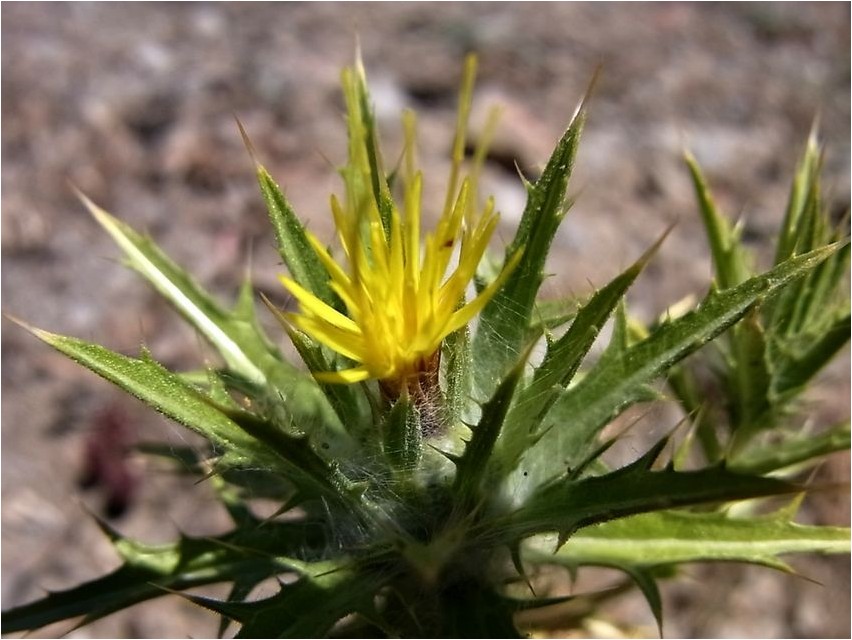
Woolly safflower is one of the plants of the family called Asteraceae or Asteraceae; in Latin the name of this plant will be as follows: Carthamus lanatus L.
As for the name of the woolly safflower family itself, in Latin it will be: Asteraceae Dumort. (Compositae Giseke).
Description of woolly safflower
Woolly safflower is an annual or biennial herbaceous plant, the height of which will vary between thirty and one hundred centimeters. The stem of this plant is straight, but in the inflorescence it will be branched. The leaves of woolly safflower will be pinnately cut, the spiny-toothed baskets are collected in an inflorescence and are oval in shape. It is noteworthy that such an inflorescence will be shrouded in apical spiny leaves. The leaves of the woolly safflower wrapper are endowed with a prickly pointed tip, and the flowers are colored yellow.
Under natural conditions, this plant is found in Central Asia, Crimea, the Caucasus, Moldova, the Lower Don region of the European part of Russia, the Black Sea region of Russia and Ukraine. Woolly safflower prefers pastures and fields to grow. It should be noted that woolly safflower is a weed.
Description of the medicinal properties of woolly safflower
Woolly safflower is endowed with very valuable healing properties, and it is recommended to use the entire plant for medicinal purposes. The presence of such valuable medicinal properties should be explained by the fatty oil content of this plant. It is noteworthy that the chemical composition of woolly safflower has not yet been fully studied.
The herb extract of this plant is active against mutants of both cancer cells and staphylococcus.

An infusion and decoction prepared from the leaves of woolly safflower are indicated for use in hysteria and jaundice, and are also used as very effective diaphoretic, choleretic and diuretic medicines. A decoction based on the fruits of this plant should be used as a very effective laxative. It is noteworthy that the fatty oil of the woolly safflower fruit is quite acceptable for consumption.
For neuroses, the following highly effective remedy based on this plant is recommended: To prepare this remedy, take one tablespoon of crushed dried safflower leaves per approximately one cup of boiling water. Let the resulting mixture steep for about one hour, then strain the safflower mixture thoroughly. Take this remedy two to three times daily before meals, one-third to one-quarter of a glass for neuroses.
For a laxative, the following highly effective remedy based on this plant is recommended: To prepare this remedy, take approximately one teaspoon of safflower berries per one full glass of water. Let the resulting mixture steep for about one hour, then strain the safflower mixture thoroughly. Take the resulting herbal remedy in the morning on an empty stomach and in the evening, one-third of a glass at a time, as a laxative. If used correctly, the positive effect will be noticeable fairly quickly, depending on the severity of the condition.