Common groundsel
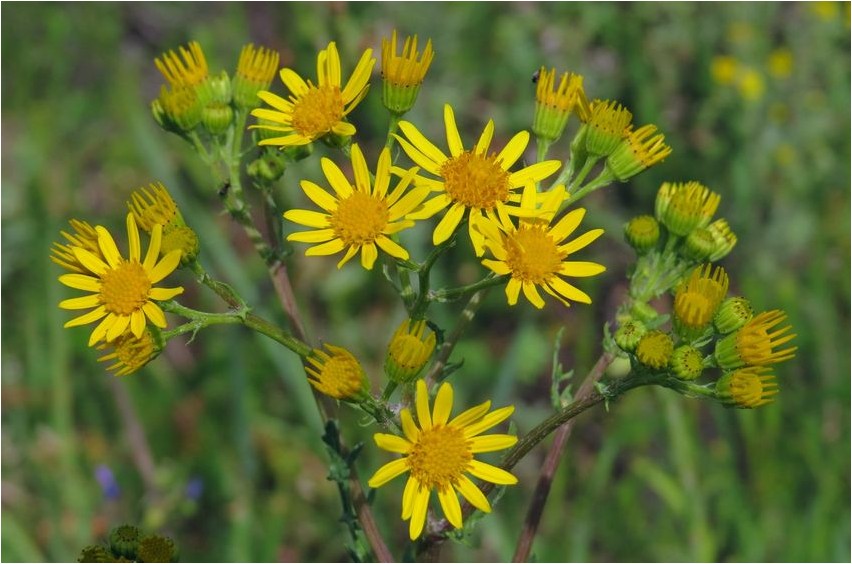
Common groundsel belongs to the family called Asteraceae or Asteraceae; in Latin the name of this plant will be as follows: Senecio vulgaris L.
As for the name of the common groundsel family itself, in Latin it will be like this: Asteraceae Dumort.
Description of common ragwort
Common groundsel is an annual or biennial herbaceous plant, endowed with a straight ribbed stem, which most often can be branched. The height of such a stem will be about twenty to one hundred centimeters. The leaves of this plant are oblong, with the lower leaves tapering into a stalk and the remaining leaves being sessile. The leaves of the common ragwort will be toothed and pinnately lobed in shape. The oblong-shaped flower baskets of this plant will be collected in a sparse inflorescence, which will be corymbose-paniculate. These flower baskets are painted in yellow tones. The fruits of common ragwort are oblong achenes.
Flowering of common ragwort continues throughout the entire summer period. Under natural conditions, this plant is found everywhere in Siberia, Ukraine and Russia. It should be noted that this plant is a weed and for this reason common groundsel is found in fields, forest edges, vegetable gardens and forest-steppes.
Description of the medicinal properties of common ragwort
Common groundsel is endowed with very valuable healing properties, and it is recommended to use the herb of this plant for medicinal purposes. It is recommended to harvest such raw materials throughout the entire flowering period of common groundsel.
The presence of such valuable healing properties should be explained by the content of mineral salts, alkaloids, ascorbic acid, rutin, seneciphylline, dye and inulin in this plant. The leaves of this plant contain carotene.

Common ragwort is endowed with anti-inflammatory, hemostatic, wound-healing, antispasmodic and hypotensive effects.
As for traditional medicine, here this plant is quite widespread. Common ragwort is recommended for use for inflammation of the large intestine and gall bladder, angina pectoris, bronchial asthma, gastrointestinal colic, as well as for exacerbation of peptic ulcer of both the stomach and duodenum. In addition, such healing agents are used as a means that will regulate menstruation and influence uterine contractions both in women in labor and during menopause. Common ragwort juice is used as a wound-healing agent for expelling worms and for hysterical convulsions. It should be noted that when handling common ragwort, the utmost degree of caution should be observed, which is due to the fact that there have been cases of poisoning through this plant in livestock. In addition, treatment with any preparations based on this plant should be carried out under the direct supervision of a physician.
For heart neurosis and angina pectoris, it is recommended to use the following remedy based on this plant: to prepare such a remedy, take ten grams of herb per forty grams of seventy percent alcohol. The resulting mixture should be infused for about two to three weeks. This healing remedy based on common ragwort should be taken three times a day, thirty drops.
Externally, for hardening of the mammary glands, hemorrhoids and furunculosis, the following remedy should be used: grind the grass with sunflower oil and then the remedy is completely ready for use.
Common groundsel
https://www. youtube. com/watch? v=Ud0WcIex6R0





