Pomeranian
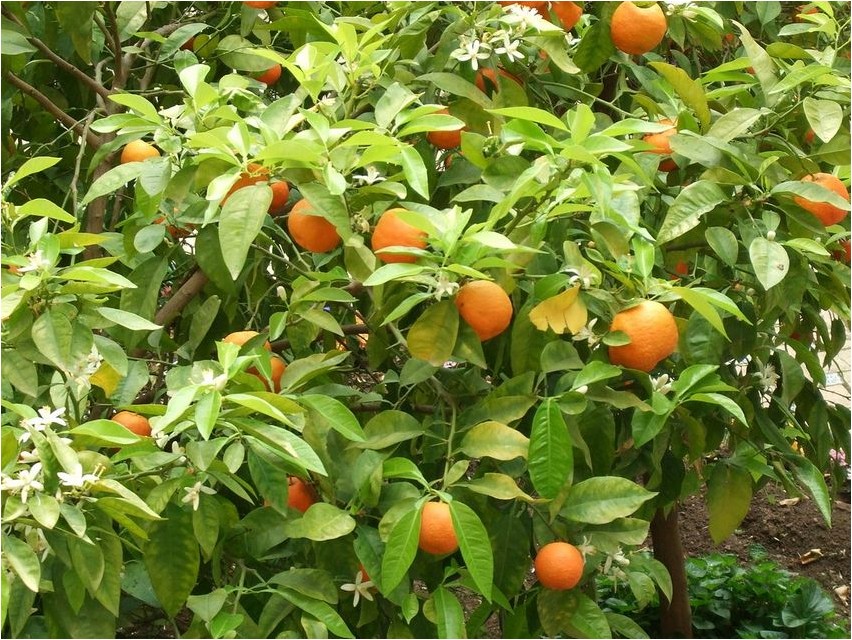
Orange (lat. Citrus aurantium) is a woody and very beautiful evergreen plant from the rather colorful Rutaceae family.
It is assumed that the orange is a hybrid of the well-known pomelo and tangerine. And it is the orange flower that is proudly called orange blossom.
Description
Pomeranian is a pretty evergreen tree of relatively small size: on average, its height varies from two to ten meters, and the height of indoor orange does not exceed one meter. Orange twigs are densely covered with very sharp, thin and long spines.
The shiny and leathery leaves of orange are petiolate and are arranged alternately. Their upper parts are characterized by a rich green color, and the lower parts of the leaves, painted in light greenish tones, are equipped with many translucent containers of essential oil. Quite long, broad-winged leaf petioles taper very sharply towards the wingless bases.
Reaching two to three centimeters in diameter, the rather large and incredibly fragrant orange flowers can be either single or connected in axillary few-flowered bunches (from two to seven flowers in each). The four- or five-toothed flower calyxes are slightly pubescent on the outside, and the corollas of each flower consist of four to eight petals. Slightly fleshy and narrowly oblong in shape, the flower petals are painted white and, like the leaves, contain containers of essential oil.
Orange fruits have a characteristic spherical or berry-shaped shape. Sometimes they can be slightly flattened, and their diameter reaches six to seven centimeters. The bright orange and rather thick skin of the fruit is characterized by a bumpy, uneven surface. It is easily detached from the pulp and also contains small containers of valuable essential oil. And the sour, even slightly bitter orange pulp is formed by ten to twelve segments. The light yellow grooved seeds of the fruit have a flattened wedge-shaped shape. It is noteworthy that the dark green ovaries of these interesting fruits appear already on the third day of flowering. As a rule, orange blossoms bloom in April or May, and its very attractive fruits ripen between November and January.

Where does it grow
The orange is native to Southeast Asia. This culture can also be found in many Mediterranean countries or in Paraguay, the Caucasus and a number of islands in the West Indies. Bitter orange is also often grown in various parts of the world as a houseplant.
Usage
Orange water, which is an infusion of flowers, was actively used in ancient times to create perfume and as an independent aromatic drink. And orange blossom, which is precisely the orange flower, has long been a traditional part of the bride’s luxurious wedding dress and her wedding bouquet.
Tinctures are prepared from well-crushed crusts of ripened fruits, which are subsequently used as an appetite stimulant or as a corrigens for the creation of various dosage forms. And unripe fruits that spontaneously fall from trees (characterized by the so-called “orange nuts” with a diameter of 5 to 15 mm) are the main raw material for extracting the essential oil used in the production of alcoholic beverages.
In addition, orange fruits are often used for medicinal purposes, and the fragrant petitgrain and incomparable neroli essential oils obtained from its leaves and flowers serve as excellent raw materials for preparing all kinds of soft drinks, as well as wonderful candied crusts and delicate marmalade. Also, these essential oils are the basis of many floral compositions when creating perfumes. And infusions of flowers have found their use in confectionery and some other branches of the food industry.
Growing
Orange grows well at temperatures from five to forty-five degrees — such a wide temperature range makes it possible to take it out into the open air as early as early June.