Bacupari
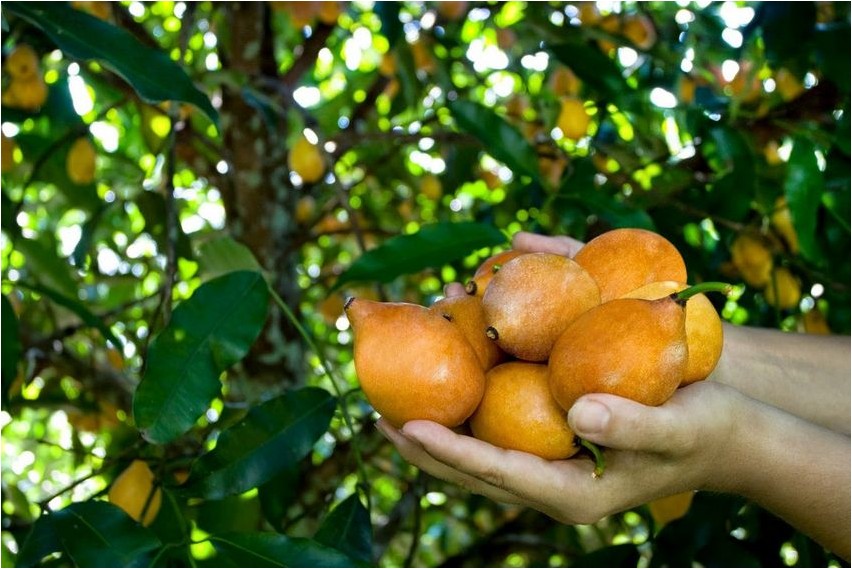
Bacupari (Latin: Garcinia gardneriana, or Rheedia brasiliensis) is a spectacular fruit tree in the Clusiaceae family. In Brazil, it”s called bacupari, while in Bolivia, it”s known as guapomo.
Description
Bacupari is a relatively small tree with a distinctive pyramidal crown. The leaves, tapering toward the base, can be oval, lanceolate, or oval-oblong. Remarkably, when damaged, all above-ground parts of the bacupari begin to secrete a significant amount of sticky, yellowish latex.
Bacupari flowers are always bisexual, and you can admire this plant in bloom in December (in the Southern Hemisphere, it blooms at the height of summer). The fruits usually ripen in January and February.
The pear-shaped or rounded bacupari fruit reaches three to four centimeters in diameter. Each fruit has a fairly flexible yet tough yellowish-orange skin. Inside the fruit is a white, very soft and pliable, translucent pulp, characterized by a surprisingly pleasant, strong aroma and excellent flavor. A pair of brownish, oblong seeds can be found in the center of the pulp.
Where it grows
Bacupari grows primarily in the wild—this plant has rarely been cultivated, even in its native region. It can be found wild in southeastern Brazil and in several adjacent regions of Bolivia and Paraguay. These fruits are sold primarily in local markets.
Uses
The pulp of the fruit is often eaten fresh or used to make delicious candies, jams, and preserves. A healthy oil is extracted from the seeds (the oil content in the seeds reaches approximately 8-9%). This oil is an excellent anti-inflammatory agent, widely used for compresses applied to tumors, wounds, boils, and other inflammatory skin lesions. This oil is also taken internally for liver enlargement.

An infusion of the pulp of these interesting fruits boasts a mild narcotic effect—comparable in strength to nicotine. Extracts of the bark and roots of this plant contain powerful antioxidants with pronounced bactericidal and antifungal properties.
Contraindications
When consuming any exotic fruits, remember to take certain precautions—the body may well react with a wide variety of allergic reactions.