Volodushka longifolia
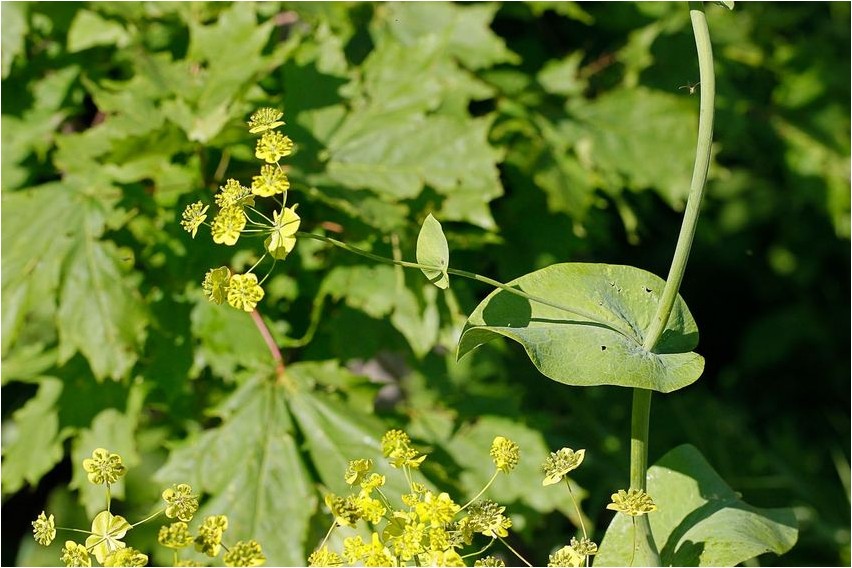
Bupleurum longifolium L.
As for the name of the longifolia family itself, in Latin it will be like this: Apiaceae Lindl.
Description of the Longifolia
Longifolia longifolia is a perennial herbaceous plant. The stems are single, straight and simple. In addition, most of these stems are weakly branched in the upper part, and the height of the stem of longifolia will be about twenty-five centimeters to one and a half meters. As for the lowest leaves of this plant, they will be oblong-obovate in shape, their length will be about twenty centimeters, and their width will be thirty-six centimeters. In this case, the mid-stem leaves are sessile, their length can vary between five and fifteen centimeters, and their width can reach from two to seven centimeters. The upper stem leaves of Longifolia are almost round and much smaller in size.
The umbrellas of this plant are large, while the lateral ones on the branches will be smaller than the axial ones; the umbrellas themselves are not numerous, they are endowed with about five to twenty rather thin rays, the length of which will be about five to seven centimeters. Such umbrellas contain fifteen to twenty flowers on relatively long stalks: approximately two to five millimeters in length. The petals are colored yellow, and the fruits are dark brown, their length will be about four to six centimeters. This plant blooms from June to July.
Volodushka longifolia has become very widespread throughout Central Asia, Siberia and the European part of Russia. For growth, this plant prefers bushes, coniferous, birch and mixed forests.
Description of the medicinal properties of longifolia
For medicinal purposes, it is recommended to use the roots, fruits and herbs of this plant. The concept of grass includes flowers, leaves and stems. It is noteworthy that the roots of this plant contain coumarins, as well as quercetin, narcissin and isorhamnetin. At the same time, alkaloids, vitamin C, carotene, carbohydrates, a related compound ribitol, as well as the following aliphatic alcohols were found in the grass: alpha-spinasterol, nonacosanol and hexacosanol. The stems, leaves and flowers of longifolia contain narcissin, rutin, quercetin, isoquercitrin and isorhamnetin. It is noteworthy that the fruits of this plant contain essential oil, as well as rutin, narcissin, quercetin, isorhamnetin and isoquercitrin.

It should be noted that longifolia is one of the most promising sources of capillary-strengthening drugs. This plant has the ability to enhance the evacuation and secretory functions of the stomach. In addition, the plant can be used for hepatitis, cholecystitis and angiocholitis.
As for its use in folk medicine, here it is used for neuroses and fever, and also as a laxative and wound healing agent. In addition, longifolia can also be used as a detoxifying agent for snake bites.
The fruits of longifolia have very valuable antiamoebic properties, and also have a normalizing effect on increasing capillary permeability.
For biliary dyskinesia, it is recommended to prepare the following remedy: for one tablespoon of the herb of this plant you will need to take one glass of boiling water. The resulting mixture is infused for two hours and then carefully filtered. This mixture should be taken about half an hour before meals, half a glass three times a day.





