Hybrid sedum
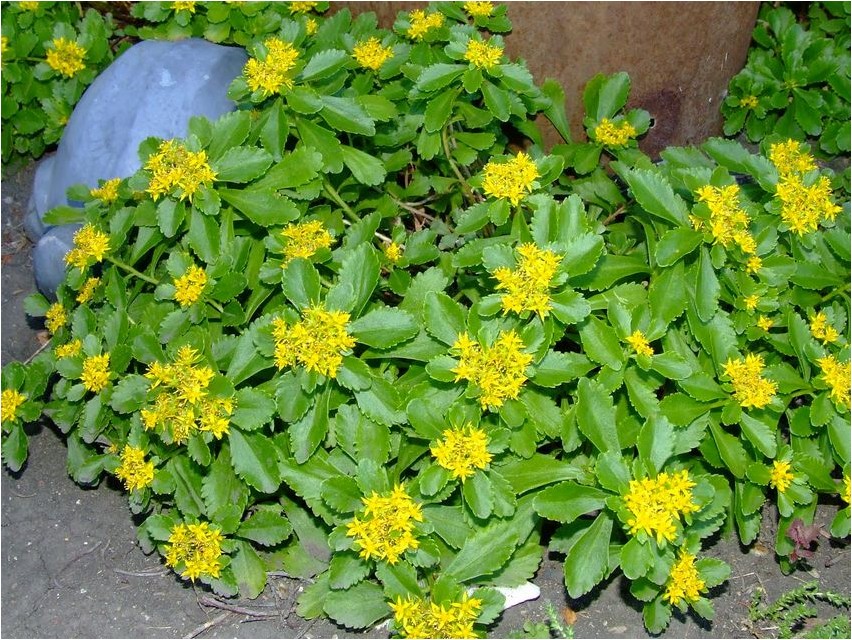
Hybrid sedum is one of the plants of the family called Crassulaceae; in Latin the name of this plant will be as follows: Sedum gibridum L.
As for the name of the hybrid sedum family itself, in Latin it will be: Crassulaceae DC.
Description of hybrid sedum
Hybrid sedum is a perennial herbaceous plant, the height of which will fluctuate between fifteen and thirty centimeters. Such a plant will be endowed with a creeping, long, branched, cord-like and woody rhizome. The stems of hybrid sedum are creeping, rooting and evergreen. The leaves will be alternate, their length is one and a half to two centimeters, and the width is about one to two centimeters, such leaves are spatulate-elliptical, and along the edge they will be blunt-toothed. The inflorescence of this plant will be apical and it is a paniculate-corymbose semi-umbrella. The corolla of the hybrid sedum will be painted in yellow tones, while the petals will be twice as long as the calyx, their length will be equal to six millimeters, and their width will be about one and a half millimeters. The seeds of this plant will be quite numerous, obtuse and elliptical, and their length will be less than one millimeter.
Flowering of hybrid sedum begins in June, while fruiting of this plant will begin in July and last until August. Under natural conditions, this plant is found in Central Asia, the European part of Russia, Western and Eastern Siberia. For growth, this plant prefers gravelly and rocky soils, sandy and pebble cliffs, rock cracks and mountain steppes. It should be noted that hybrid sedum is a very ornamental plant.
Description of the medicinal properties of hybrid sedum
Hybrid sedum is endowed with very valuable healing properties, and it is recommended to use the herb of this plant for medicinal purposes. The concept of grass includes flowers, leaves and stems.
The presence of such valuable healing properties is recommended to be explained by the content of anthraquinones, coumarins, tannins, phenols and their derivative arbutin, as well as the following carbohydrates in the composition of this plant: fructose, sucrose, sedoheptulose and glucose. The herb will contain phenols, flavonoids, tannins, esculetin, abutin, alkaloids, oleic acid, beta-sitosterol and organic acids: malic, citric and oxalic.

Remarkably, experimental studies have shown that the herb extract stimulates the nervous system, has antidepressant and anti-inflammatory effects, and inhibits the development of leukocytosis.
An infusion made from the herb of the hybrid sedum is recommended for goiter and is also used as a laxative, hemostatic, diuretic, and a tonic for the nervous system. This infusion of the hybrid sedum is also used for gastrointestinal ailments and menorrhagia. As for the topical use of the fresh leaves of this plant, they are used for ulcers, wounds, and bruises.
For goiter, the following highly effective remedy based on this herb is recommended: to prepare this remedy, take seven tablespoons of dry, crushed sedum herb per cup of boiling water. Then, let the mixture steep for two hours, after which the healing remedy should be thoroughly strained. Take this remedy three times daily, one to two tablespoons.