Seaside plantain
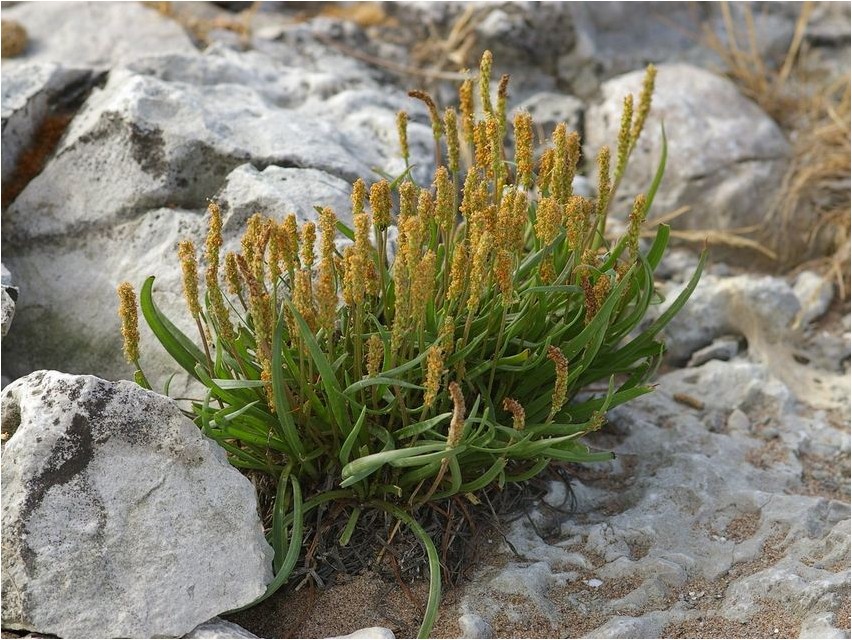
The seaside plantain is one of the plants of the family called plantains; in Latin the name of this plant will be as follows: Plantago maritima L.
As for the name of the seaside plantain family itself, in Latin it will be: Plantaginaceae Juss.
Description of seaside plantain
The seaside plantain is a perennial herbaceous plant whose height will vary between ten and sixty centimeters. The root of such a plant is a tap root. The leaves of the seaside plantain can be from elliptical to linear-lanceolate, such leaves will be sharp, slightly toothed with crown-five veins or entire, densely hairy or glabrous. The peduncles of the seaside plantain are most often pubescent, they are longitudinal, the height, together with a short ovoid or cylindrical spike, will be about sixty centimeters, while the two front sepals grow together into two-lobed scales. The fruits of this plant are a capsule, which in turn will be endowed with two seeds.
The flowering of seaside plantain occurs in the summer. Under natural conditions, this plant is found in Central Asia, the European part of Russia, the European Arctic, the Irtysh and Upper Tobolsk regions of Western Siberia, and the Daur and Angara-Sayan regions of Eastern Siberia. For growth, this plant prefers dry slopes, light forests, clearings, meadows, places along roads, pebbles, seaside lawns, saline meadows and salt marshes.
Description of the medicinal properties of seaside plantain
The seaside plantain is endowed with very valuable healing properties, and it is recommended to use the leaves and the entire above-ground part of this plant for medicinal purposes.
The presence of such valuable healing properties is recommended to be explained by the content of cholesterol, stachyose, steroids, aucubin iridoid and higher fatty acid in the composition of this plant. The seeds of the seaside plantain, in turn, will contain the iridoid aucubin and ribose.

Seaside plantain is used in the treatment of urolithiasis. In the form of an infusion and decoction, the aerial part of the seaside plantain is recommended in Tibetan medicine for pulmonary tuberculosis, pneumonia and various gastrointestinal diseases. It is noteworthy that the leaves of this plant can be used to make salads.
For urolithiasis, the following highly effective remedy based on this plant is recommended: to prepare this remedy, take three tablespoons of sea plantain leaves per half a liter of boiling water. The resulting medicinal mixture should be steeped for approximately two hours, after which it should be thoroughly strained. Take this sea plantain-based remedy three times daily, half a glass or one-third of a glass.
For tuberculosis, peptic ulcers, gastritis, and pneumonia, the following remedy is used: to prepare it, take fifteen grams of crushed sea plantain aerial parts per glass of boiling water. Let this mixture steep for two hours, after which it is recommended to strain the resulting sea plantain-based remedy very thoroughly. Take this highly effective remedy based on this plant three times daily, one-third of a glass. It is noteworthy that with proper use, the positive effect will be noticeable quite quickly. Seaside plantain





