Spoonweed
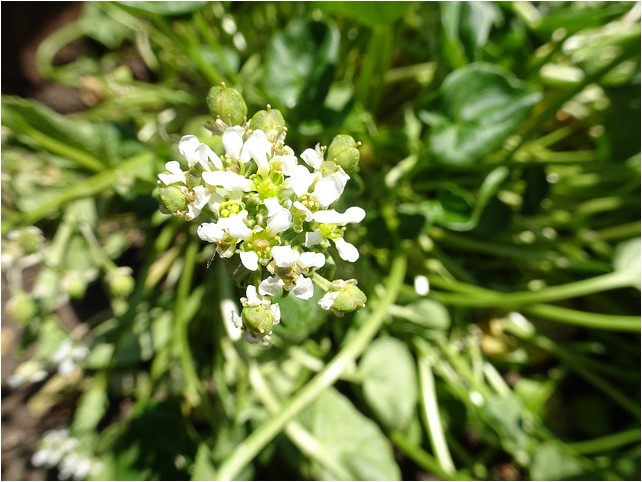
Spoonweed is a member of the Brassicaceae or Cruciferae family. Its Latin name is Cochlearia officinalis (L.).
The family name of Spoonweed itself is Brassicaceae Burnett (Cruciferae Juss.).
Description of Spoonweed
Spoonweed is also known by the following common names: horseradish, scurvy grass, and sea lettuce. Spoonweed is a biennial or perennial succulent herbaceous plant, reaching a height of between thirty and forty centimeters. Its root is thin and spindle-shaped, with numerous lobes of rather fine roots. The arctic spoonwort’s stem is branched and erect, with long-petiolate, broadly oval basal leaves, ovate mid-leaves, and clasping upper leaves.
The flowers of the arctic spoonwort are white, with a corolla consisting of four petals and a calyx, which in turn consists of four sepals. This plant has only six stamens, and the pistil bears a superior ovary consisting of two fused carpels. The fruits of the arctic spoonwort are rounded-ovate pods that sit on fairly long stalks. Flowering occurs from May to June. In the wild, the spoonwort is found in the European Arctic and on the White Sea coast in the Dvina-Pechora region of European Russia. Generally, this plant can be found in North America, the Arctic, and the European Arctic. The spoonwort prefers lakeshores, riverbanks, and seashores, as well as coastal valley meadows, especially in the tundra zone.
Description of the medicinal properties of the spoonwort
The common spoonwort possesses valuable medicinal properties, and its herb and seeds are recommended for medicinal purposes. The herb includes the leaves, flowers, and stems of this plant. These valuable medicinal properties are attributed to the vitamin C content of the leaves, while the seeds contain a fatty oil.
It should be noted that the fresh aerial parts of this plant are used as a very effective diuretic in homeopathy. Infusions and decoctions prepared from the herb of this plant are recommended for rashes, scabies, skin diseases, dental caries, ringworm, purulent wounds, sore throats, laryngitis, stomatitis, gingivitis, gonorrhea, nausea, dizziness, kidney and prostate diseases, lumbago, gout, sciatica, various gynecological diseases, neuralgia, and impotence. Furthermore, this remedy is used as an antiscorbutic and as a diuretic for edema and ascites.

In folk medicine, remedies based on the herb of this plant are quite widespread. An alcohol tincture of this herb is recommended for skin diseases, especially inflammatory skin conditions accompanied by itching. In addition, this remedy based on the medicinal spoonweed is also used for various urinary tract diseases.
Bittercress (spoonweed, spoonweed, varukha, seaweed, scurvy grass) Spice.