Chingil
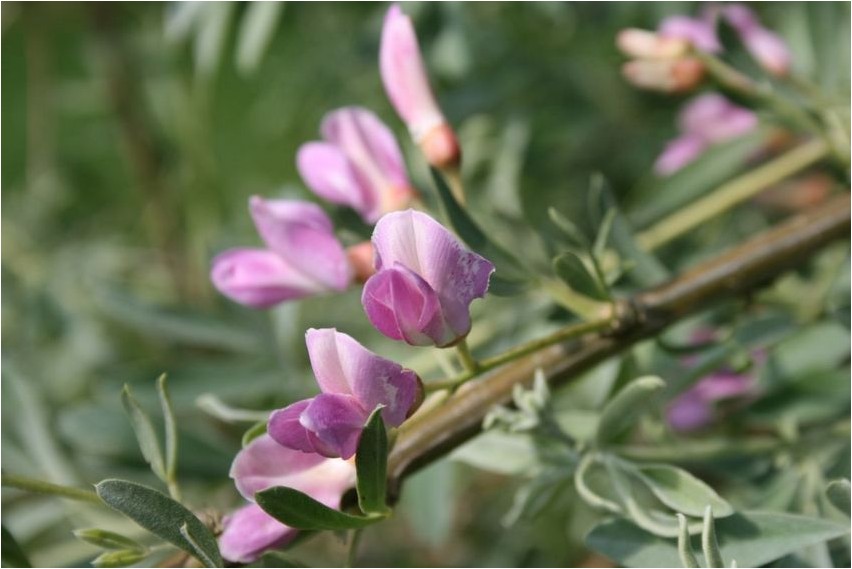
Chingil (lat. Halimodendron) is a monotypic genus of shrubs of the Legume family. The plant is known under the names shengil and chemysh. The genus is represented by one single species — silver chingil.
Chingil is distributed in the countries of Central Asia, Mongolia, Kazakhstan, Pakistan, Afghanistan, Turkey, Iran, in the European part of Russia, as well as in Ukraine. In California, chingil is considered a dangerous invasive weed.
Characteristics of culture
Chingil is a deciduous thorny shrub up to 2 m high with a spreading crown. The bark is gray, cracking. The shoots are pubescent over the entire surface, equipped with long spines (2-7 cm).
The leaves are pinnate, alternate, with two spiny, subulate-shaped stipules, consisting of 1-5 pairs of leaflets. The leaves are quite small, obovate, up to 3 cm long, silky, pubescent, silvery in color. In summer, the leaves become grayish-green in color, and in autumn — yellowish-green.
The flowers are pink, pale pink or light purple, collected in axillary umbellate inflorescences, similar in appearance to pea flowers. The fruit is a swollen leathery bean, brown when ripe. The seeds are dark olive or brown, kidney-shaped. Chingil blooms in June-July for 7-10 days. The fruits ripen in August-September.

Growing conditions
In general, chingil is not picky about growing conditions. The composition of the soil is not of fundamental importance; the plant grows without problems in saline soils. The crop cannot tolerate only waterlogged soils, as well as low-lying areas with stagnant melt water. Areas for chingil are preferably illuminated as much as possible.
Reproduction and planting
Chingil is propagated by seeds, shoots and grafting. The seeds do not need pre-sowing treatment, although it is advisable to scald them with boiling water or scarify them by pricking them with a needle. Sow the seeds immediately in a permanent place. Chingil seedlings develop very quickly and form a powerful root system, so transplantation is viewed negatively.
Reproduction by root suckers is difficult, but this problem can be solved by grafting chingil onto a standard of yellow acacia, or Caragana arborescens. Chingil, grafted onto a standard, forms a very graceful bush with thin silvery branches. In general, caragana tree, due to its bush-like shape, is not ideal for rootstock in its pure form, so gardeners use double grafting.
A caragana shoot 1. 5 m long is grafted onto the roots of Robinia, and only then chingil is grafted onto it. From time to time, an acacia shoot forms at the base of the trunk; it is easily removed, so it does not cause any special problems and does not interfere with the formation of a powerful trunk.
Application
Chingil blooms very impressively, although it only lasts 7-10 days. However, even after flowering, the shrubs do not lose their decorative value due to the persistent silver color of the foliage. Chingil is used for landscaping parks and gardens, creating hedges and protective afforestation. Standard forms of chingil are acceptable as tapeworms on the lawn. The crop is also suitable for decorating sandy and rocky areas.
Chingil
https://www. youtube. com/watch? v=x1c-oN14mqM