Coreopsis whorled
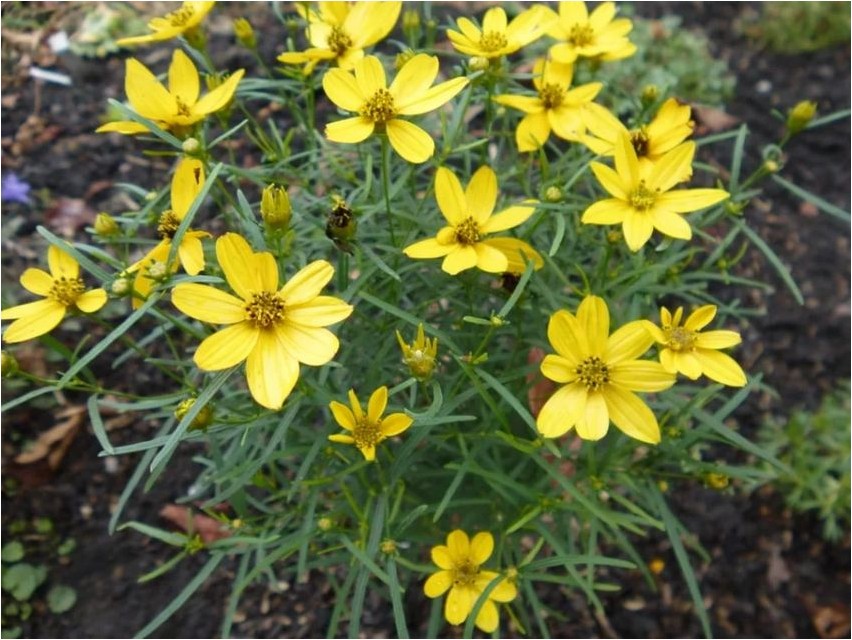
Flowers Whorled Coreopsis (lat. Coreopsis verticillata) is a herbaceous rhizomatous perennial from the genus Coreopsis (Coreopsis), included by botanists in the Asteraceae family.
A fairly typical representative of the genus with sunny yellow petals of flower inflorescences, reminiscent of the petals of an ornamental sunflower; tolerant of dry and infertile soil; lover of places open to sunlight.
Description
With its underground, rapidly growing rhizome, Coreopsis whorled is similar to Coreopsis rosea. It quickly forms dense clumps on the surface of the earth, revealing to the world a stringy stem with numerous side stems and leaving no chance for other plants to live. Therefore, for the growth of Coreopsis whorled, an eye and an eye are needed.
The thread-like segments of the plant”s three-fingered leaves give the bush the appearance of a castle in the air. Several leaves are located in one place of the stem, bending their sharp tips in different directions from the support and forming something like a cup. Botanists call such a “structure” a “cluster.”
A thin short peduncle is born from the cluster, bearing one inflorescence. The inflorescence basket, consisting of two types of flowers, like the inflorescences of all Asteraceae, is painted a monotonous yellow color. That is, both the ligulate marginal flowers and the tubular middle flowers decorate the world with yellow sunny tones. The flowers are very loved by butterflies, which give a special color to the entire plant.
After pollination, the female flowers develop into a fruit called an “achene”. They have such a funny appearance that you can confuse the fruit with an insect such as a small tick or brown bug. “Achenka” inspired botanists to name the entire genus of plants. The word “coreopsis” combines two Greek words, which are translated into Russian in several ways: “bug and species”; “insect and mite.” So, not only the Russian language is distinguished by its richness of images, but also the ancient Greek language, which served as the basis for the names of many things that serve man.

Growing
Perhaps the similarity between the two species of plants of the genus, such as “Coreopsis whorled” and “Coreopsis pink”, ends with the similarity of their nimble rhizomes, the thinness of the leaf blades and the shape of the inflorescence-basket.
When it comes to living conditions, there are differences. A lover of moisture, “Coreopsis pink” chooses swampy places for itself, but “Coreopsis whorled” does not like dampness, and therefore prefers dry or medium-humidity soils. It thrives on rocky or sandy soils with good drainage, poor in organic matter, and easily tolerates the dry period of nature.
In the middle or towards the end of the summer, you can trim the bushes to maintain their decorative appearance. At the same time, untidy or overgrown foliage is removed and the plant is stimulated to bloom again.
Coreopsis whorled is propagated by dividing the rhizome or by sowing seeds. The plant is prone to self-sowing and rhizome growth, thereby requiring the attention of a gardener who does not need a flower garden with one type of plant, even a very decorative one.
Pests
In general, Coreopsis whorled is a fairly resistant plant that can resist pests and diseases. But in conditions of high humidity or dampness, snails and vile, voracious slugs can visit, and microscopic soil fungi can turn the root system into rot, and powdery mildew can spoil the airiness of green leaves.
Usage
Whorled coreopsis will be a good decorative decoration for an area with poor, dry soil, which the summer resident does not yet have the energy or time to cultivate. As work on fertilizing the soil progresses, it can be easily replaced with more whimsical plants, so that there is something to pleasantly surprise friends and neighbors.
From tall varieties (up to 100 cm), you can make a dense green hedge, which throughout the summer season will make the area brighter and happier with its sunny yellow inflorescences, abundantly covering the bushes, without requiring special care and time.
Lower varieties of Coreopsis whorled are suitable for graceful airy flower borders, adding mystery to the garden path leading into the very depths of the summer cottage.





