Peach palm
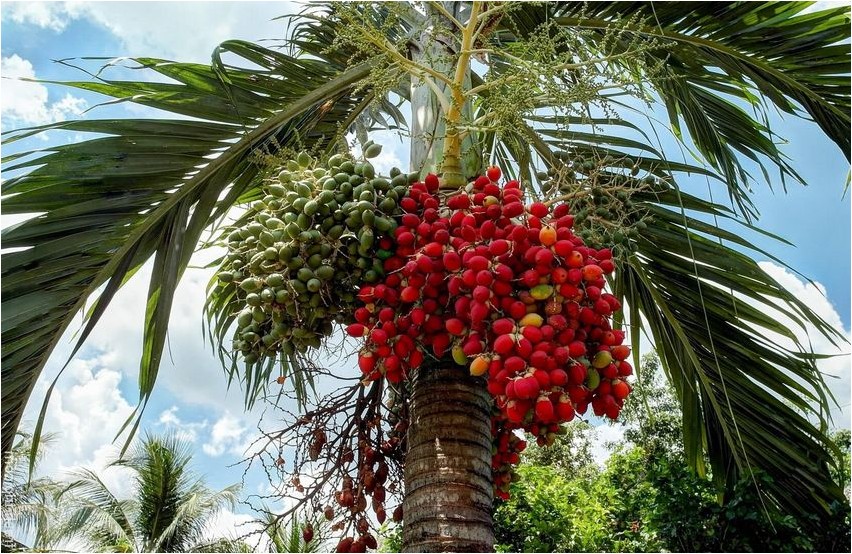
Peach palm (lat. Bactris gasipaes) is a fruit crop representing the Palm family.
Description
The peach palm is a slender and fairly tall tree, the height of which ranges from twenty to thirty meters. At the top, its mighty trunks (though sometimes along the entire length) are covered by impressive rings of black, needle-shaped spines, the length of which can reach twelve centimeters. Such thorns make it very difficult to collect fruits.
The leaves of this crop are very long — their length can reach from 2. 4 to 3. 6 meters. All of them are lanceolate and pinnately complex, boasting a rich dark green color and rather spiny edges. However, the petioles are also densely strewn with numerous spines.
Small yellowish-whitish flowers form inflorescences up to thirty centimeters long. All inflorescences are located directly under the tree crowns, while the same raceme contains both female and male flowers.
The fruits, hanging in clusters of up to a hundred pieces each, can be either red, orange or yellow. And their shape can be conical, cup-shaped or oval. Each fruit has six vaguely defined edges and reaches six centimeters in length. Under the thin skin of the fruit there is a sweet yellowish-orange pulp, and in the center of this pulp there is a single stone of very impressive size.
The peach palm begins to produce a harvest already in the third or fourth year of its life.

Where does it grow
This type of palm is native to the Ecuadorian, Colombian, Peruvian and Brazilian jungles. Since ancient times, the peach palm has been actively grown and no less actively distributed by numerous Indian tribes throughout the Amazon, but this crop received its highest economic importance only in Costa Rica. In the last few decades, this crop began to be grown in some Central American countries — in Panama and Nicaragua, as well as in Honduras and Guatemala. In addition, such a palm can be found in the Antilles, as well as in the northern regions of South America. Back in 1924, the first such plantings appeared in the Philippines, and by 1970 this amazing plant reached India.
In fact, this palm tree is capable of growing in any area characterized by a hot and fairly humid tropical climate. This culture can reproduce both through seeds and vegetatively; it is completely undemanding to soils.
Application
It is not customary to eat fresh peach palm fruits. True, it is fresh fruits that parrots of various species love very much, but as the luxurious tropical forests located in the Amazon basin are cut down, the number of these beautiful birds is gradually declining. And before eating, people boil these fruits for two or three hours in salted water, often adding butter or vegetable oil. Before putting them to boil, the skin of each fruit should be slightly cut. And they should be eaten while still warm.
Most often, these fruits are used as a side dish for a wide variety of fatty dishes, or they are simply eaten with various gravies — the fact is that even boiled pulp is always a little dry.
Sometimes the pulp of these fruits is added to baked goods; in addition, a strong and very rich alcoholic drink is obtained from it. And gourmets willingly eat the kernels of the seeds, which taste like coconut.
If the fruits were collected carefully and do not have dents, then they can easily be stored in familiar room conditions for a week.
The soft cores of the upper parts of the trunks are no less actively used — they are eaten raw or various dishes are prepared from them. Quite often they are used for preservation. By the way, the taste of fresh hearts is very similar to the taste of celery stalks.
The wood of such a palm tree is an excellent building material, and local tribes use the leaves to construct roofs for their huts. A decoction is also prepared from the leaves, often used by Indians for headaches or abdominal pain.
Contraindications
Due to individual intolerance, allergic reactions cannot be completely ruled out.