Autumn kulbaba
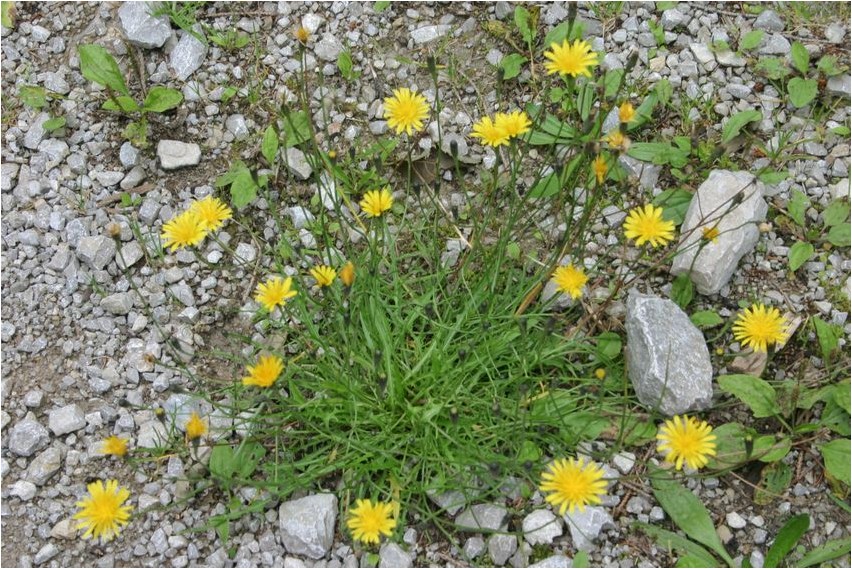
Autumn kulbaba is one of the plants of the family called Asteraceae or Asteraceae; in Latin the name of this plant will be as follows: Leontodon autumnalis L.
As for the name of the autumn kulbab family itself, in Latin it will be: Asteraceae Dumort.
Description of autumn kulbaba
Autumn kulbaba is also known by the following popular names: moss, jaundice, bitter, jaundice, goldenrod, goiter, spurge and scrofulous grass. Autumn kulbaba is a perennial herbaceous plant, the height of which will vary between eight and sixty-five centimeters. The leaves of this plant are basal, narrow and rather long, and also pinnately divided. The stem of the autumn kulbab will be leafless and branched, it will be endowed with two to four baskets, which will be on rather long legs. Such legs will gradually thicken upward and are equipped with numerous scaly bracts. It is noteworthy that until the flowers bloom, the baskets of this plant will be erect.
Autumn kulbaba flowers are reed-shaped and they are colored yellow. The fruits of the achene will be slightly curved and valval, transversely and longitudinally furrowed. The pappus of the autumn kulbab achenes will be two-rowed, it consists of feathery hairs, while the inner hairs will be fused at the base.
Autumn kulbabu blooms from the second half of summer to late autumn. Under natural conditions, this plant is found in the European part of Russia, the Arctic, Western Siberia, Ukraine, the Caucasus, Central Asia, Central Europe and Scandinavia. For growth, this plant prefers edges, forest glades, meadows, pastures, crops, places near roads and near housing. It is noteworthy that autumn kulbab is also a very valuable honey plant.
Description of the medicinal properties of autumn kulbaba
Autumn dandelion possesses valuable medicinal properties, and its herb is recommended for medicinal purposes. The herb includes the leaves, stems, and flowers of this plant. These valuable medicinal properties are attributed to its content of tannins, nectar, sucrose, flavonoids, vitamin tocopherol, alkaloids, steroids, carotenoids, beta-sitosterol, and the following terpenoids: yakvilenine, alpha-amyrin, beta-amyrin, and 8-deoxylactucin. A fatty oil has been found in the seeds of this plant.

A decoction made from autumn dandelion herb is recommended for various respiratory infections and coughs. Externally, this remedy, applied as a bath, is a sedative intended for children. A decoction and infusion of this herb is recommended for various liver diseases and biliary dyskinesia. For biliary dyskinesia, the following remedy based on this plant is recommended: to prepare this remedy using autumn dandelion, take three tablespoons of dried, crushed herb per half liter of water. Boil the resulting mixture for approximately three to four minutes, then let it steep for one hour and strain thoroughly. Take this autumn dandelion-based remedy thirty to forty minutes before meals, three to four times daily, one-third to one-quarter cup at a time. It is very important to follow all the instructions for taking and preparing this healing remedy based on this plant.
What did the dandelion tell you?





