Creeping bitterweed
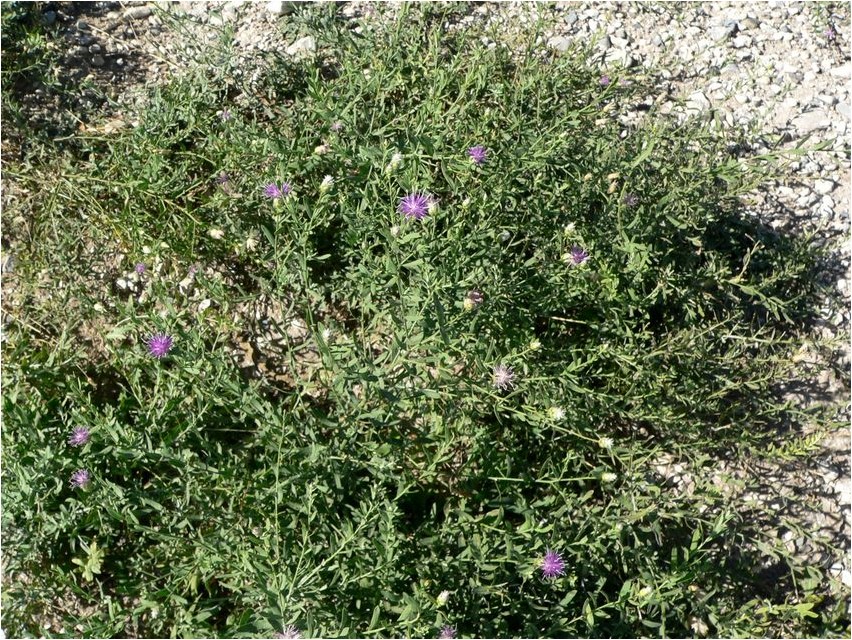
Creeping bitterweed is one of the plants of the family called Asteraceae or Asteraceae. In Latin, the name of this plant will be as follows: Acroptilon repens (L.).
As for the name of the creeping mustard family itself, in Latin it will be like this: Asteraceae Dumort.
Description of creeping bitterweed
Creeping bitterweed is a perennial herbaceous plant, the height of which can vary between fifteen and seventy-five centimeters. The root of this plant is taproot and also very long: its length can even reach six meters. The length of the lateral root shoots will be about one meter; the stem can be either single or two or three. The stem of creeping bitterweed is erect and ribbed, and also highly branched. The color of such a stem will be grayish. The leaves are rigid, they can be oblong to almost linear, and at the top the leaves are endowed with a very small point. The baskets are located at the tops of the stem and its lateral branches; such baskets will be single. The baskets of creeping bitterweed are collected in a spreading racemose-corymbose or paniculate inflorescence. The flowers of this plant are colored pink, the length of the achene will be about three to four millimeters, and the width will be approximately two millimeters, the length of the pappus will be about eight to eleven millimeters.
Creeping mustard blooms from May to August. Under natural conditions, this plant can be found in the European part of Russia, Central Asia, Western Siberia, as well as the Black Sea region of Ukraine. For growth, this plant prefers salt marshes, saline meadows, steppes, rocky shores of lakes and rivers, as well as fallow lands, crops, clay slopes and places along roads from lowlands to an altitude of about three thousand meters above sea level. It should be noted that creeping bitterweed is a quarantine weed.
Description of the medicinal properties of creeping mustard
It is recommended to use the fruits and herbs of this plant for medicinal purposes. The concept of grass includes the leaves, flowers and stems of creeping bitterweed. The presence of such valuable healing properties is explained by the rubber content of the plant, while the leaves and inflorescences of this plant contain the following sesquiterpenoids: acroptylene and repin.
A decoction prepared from the herb of this plant is recommended for use for epilepsy and malaria, and the crushed herb is used externally for scabies.

For coughs and pulmonary tuberculosis, it is recommended to use the following quite effective remedy based on creeping mustard: to prepare it you will need to take one tablespoon of crushed herb of this plant for about half a liter of water. The resulting mixture should be boiled over very low heat for approximately three to four minutes, and then left to steep for two hours. After this, this mixture based on creeping bittersweet should be filtered very carefully. It should be noted that in order to achieve a greater degree of effectiveness when using such a product, it is recommended not only to comply with all the conditions for preparing this product, but also all the rules for its administration. It is recommended to take this remedy either half a glass or one third of a glass three times a day after a meal.
It is important to remember that other healing properties are also attributed to creeping bitterweed, but they have not yet received official use. Perhaps very soon new ways of using this medicinal plant will appear.





