Common gum
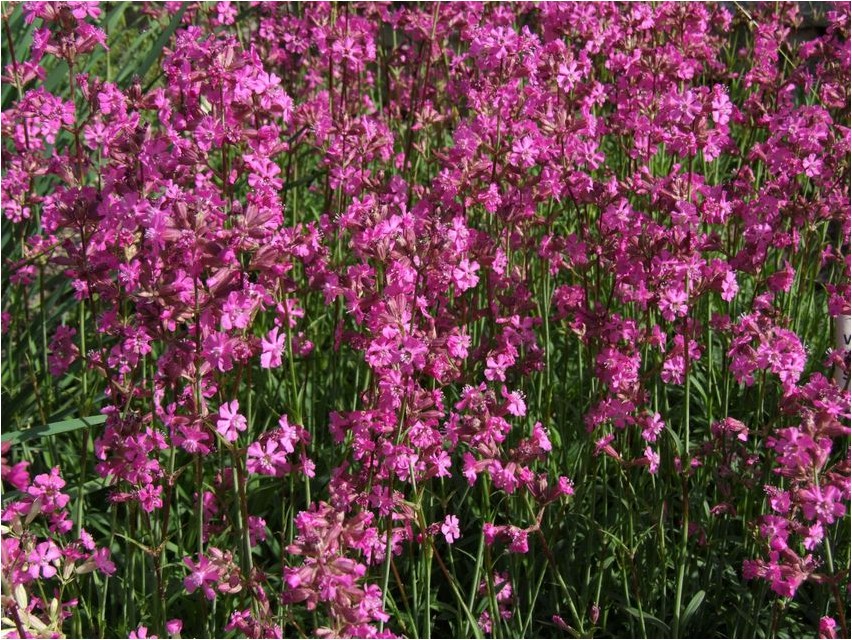
Common gum is one of the plants of the family called Cloveaceae; in Latin the name of this plant will be as follows: Viscaria vulgaris Bernh. (V. viscosa Scop.) Aschers.
As for the name of the common gum family itself, in Latin it will be: Caryophyllaceae Juss.
Description of common tar
Common tar is known under numerous popular names: resinous drowsiness, adonis, magpie glue, sticky, tar, sticky, light, semi-flower, sleep-grass sorochal, snyaka and linden. Common gum is a perennial herbaceous plant whose height will vary between thirty and eighty centimeters. The stem of such a plant can be either simple or weakly branched, and sometimes it is also slightly pubescent. At the top, the stem of the common gum will be sticky, it is endowed with stem basal leaves. The basal leaves of this plant will be linear-lanceolate and petiolate, while the stem leaves are sessile, they grow together at the base into rather short sheaths, and will be ciliated at the very base. The width of the stem leaves is about two and a half to five centimeters, while the length will be equal to two to seven centimeters. Five to six flowers of this plant are collected in whorls and will also form a racemose panicle. The calyx of the common gum is tubular, ordinary and slightly swollen, the width of such a calyx is four to five millimeters, and the length is about ten to twelve millimeters, such a calyx is endowed with veins and blunt teeth of a triangular shape. The petals of this plant are painted in crimson tones, but can be white and are endowed with a whole limb, and at the base there will be two appendages. The seeds of the common gum are kidney-shaped, they are endowed with small tubercles, and will also be compressed until mid-summer.
The flowering of this plant begins at the end of the spring period. Under natural conditions, common tar is found in Ukraine, the Caucasus, Moldova, Belarus, Western Siberia and the European part of Russia. For growth, this plant prefers steppe depressions, hillsides, dry meadows and forest edges.
Description of the medicinal properties of common tar
Common gum is endowed with very valuable healing properties, and it is recommended to use the herb of this plant for medicinal purposes. The term grass includes leaves, stems and flowers. Such medicinal raw materials should be prepared from May to June. The presence of such valuable healing properties should be explained by the content of phenol carbonic acids, saponin saporubin and the following flavonoids in this plant: homoorientin, vitexin, orientin and saponaretin. The roots of this plant contain phenolic glycosides and saponin triterpene viscoside.
As for traditional medicine, here this plant is quite widespread. Common tar is endowed with very effective hypnotic, anti-inflammatory, expectorant, wound healing, hemostatic, antiseptic, analgesic and choleretic effects.

An infusion prepared from the herb tar vulgaris is indicated for use in hepatitis, various kidney diseases and jaundice, and this healing agent is also used as an expectorant for various uterine bleeding, pneumonia, painful menstruation, bronchitis and gastrointestinal colic. It is also permissible to use an infusion prepared from the herb resin as a sleeping pill.





