Euonymus
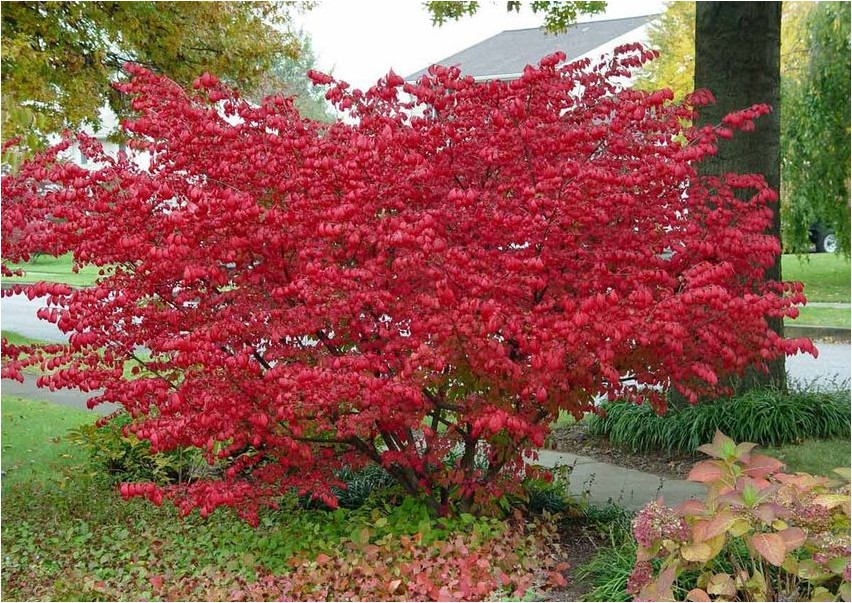
Euonymus (Latin: Euonymus) is a genus of woody plants in the family Celastraceae. In the wild, euonymus grows in the undergrowth of mixed and broadleaf forests, primarily in temperate and subtropical zones, excluding the far north. The genus currently includes over 200 species.
Cultivated Characteristics
Euonymus is a deciduous or evergreen shrub up to 10 m tall, with tetrahedral or rounded shoots with corky growths and a decorative, lacy crown. The leaves are smooth, opposite, light green or green, ovate, elliptical, lanceolate, or oblong. In autumn, the leaves turn white, yellow, orange, pink, red, purple, or carmine. The flowers are inconspicuous, small, five-petaled, greenish or brownish in color, gathered in racemose or corymbose inflorescences, opening immediately after the leaves unfurl.
The fruit is a four-part capsule, spiny or winged, leathery, and dry. Unripe fruits are pale green; when ripe, they turn pink, scarlet, crimson, burgundy, dark purple, or yellow. The seeds are red, white, or brownish-black, with an aril, covered with fleshy tissue. Euonymus blooms in May-June. Euonymus cannot be called a beautiful flowering plant; it is valued only for its lacy foliage (especially in autumn) and brightly colored fruits. Euonymus is a poisonous plant.
Growing Conditions
Euonymus prefers slightly alkaline or neutral, fertilized, moderately moist soils. Each species has a different tolerance for light intensity. For example, the warty euonymus thrives in semi-shaded areas, while the European euonymus prefers full sun. Most euonymus species have a spreading, shallow root system, so they can grow in areas with a thin soil layer. The plant is characterized by increased drought and frost resistance. However, the plants do not respond well to overwatering.

Propagation and planting
Euonymus is propagated by seeds, root suckers, green cuttings and dividing the bush. The seed method is difficult. Before sowing, the seeds are stratified at a temperature of 2-3C for four months; usually, with this treatment, up to 70-80% of the seeds hatch. Stratified seeds are washed, cleared of seedlings and pickled in a weak solution of potassium permanganate. The seeds are sown in a substrate composed of leaf and turf soil, humus and sand in a ratio of 4:1:2:1. The seeding depth is 2 cm. The first shoots appear in 14-20 days. Young plants are transplanted to a permanent place in the third year.
Cuttings are carried out at the end of summer. The cuttings should be 6-10 cm long and have one internode. Cuttings of cuttings are treated with phytohormonal powder or a growth stimulator, only after that they are planted in a mixture of sand and peat and covered with polyethylene. The cuttings take root after 1. 5-2 months, at which time they are transplanted to a permanent place. In winter, young plants are mulched with a thick layer of peat or healthy fallen leaves. Euonymuses grown in this way begin to bear fruit at 4-5 years.
Care
Euonymus plants are unpretentious plants; caring for them involves standard procedures for most crops, including weeding and loosening the soil near the trunk or near-stem zone, fertilizing, watering and pruning. Euonymus responds well to soil aeration; compaction should not be allowed.
To maintain a beautiful crown, plants undergo formative pruning. In variegated euonymus, the green branches that form are also removed. Sanitary pruning is also necessary. Fertilizers for the crop are acceptable, both organic and mineral. 2-3 fertilizing per season is sufficient; fertilizing before fruiting is required.
Quite often, euonymus is affected by various pests. The most dangerous for plants are scale insects, spider mites, apple moths, aphids and red flat mites. To combat them, a solution of the drug “Actellik” or any other approved insecticides is effective.
Application
Euonymus is widely used in landscape design of gardens and parks. Creeping forms, in particular Koopmann”s euonymus, Fortune”s euonymus and dwarf euonymus, form thick, dense carpets under favorable growth conditions; they are suitable for landscaping shady areas. Due to the fact that euonymus tolerates formative pruning without any problems, they can be used to create hedges. Plants are often used in group and solitary plantings.