Violet tricolor
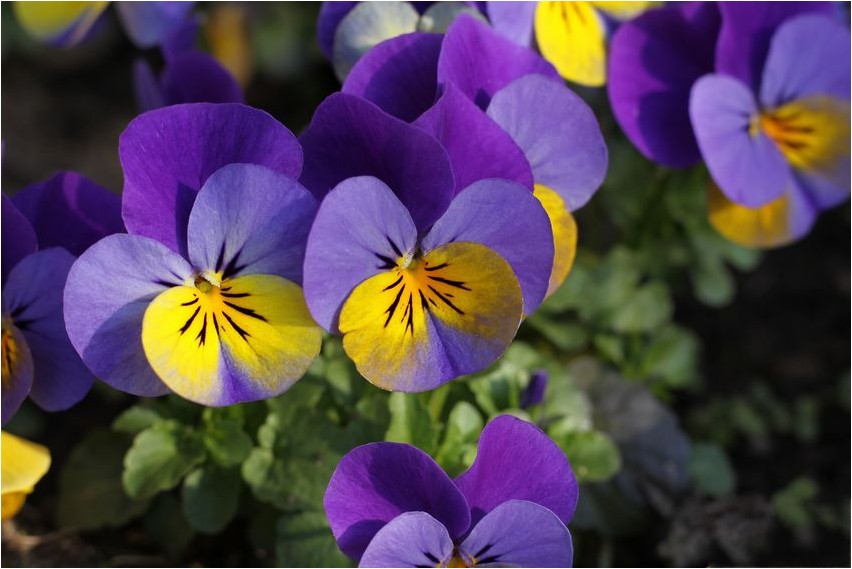
Tricolor violet (lat. Viola tricolor) is a resilient herbaceous plant of the genus Violet (lat. Viola) of the violet family (lat. Violaceae).
Tricolor violet is a very unpretentious plant, often invading cultivated plantings as a weed. The vitality and resilience of plants in the face of natural adversity, combined with cute tricolor flowering, enabled breeders to develop new ornamental varieties that display bright and large flowers, thanks to which Violet tricolor has become a real “queen of flower beds.” The herb of wild violet tricolor has healing abilities.
What’s in your name
The first word of the plant’s Latin name, “Viola,” translates as “purple.” Botanists, when assigning this name, relied on the color of the flowers, which is characteristic of most natural plant species of the genus.
The specific epithet “tricolor” is clear, practically, without looking in a dictionary. The three colors in which nature dressed the delicate petals of the most viable representative of the genus formed its basis.
Description
In contrast to the thick woody rhizome of the amazing violet (lat. Viola mirabilis), the underground part of the tricolor violet consists of a thin taproot with a slightly branched network of lateral roots.
Plants of this species can be biennial, which survive the cold winter period by retaining the root, while the above-ground parts die off, being reborn in the spring from buds on the roots. Botanical science calls such plants “hemicryptophytes.” Or they can also be annual, when every spring a new plant is born from seeds that have overwintered in the soil. Such plants are called “therophytes”.

From the root, a stem or several branching stems, which can be erect or creeping, rise to the surface of the earth. The triangular stem is hollow inside, with a bare or pubescent surface, ranging in height from 10 to 45 centimeters.
Large-crowned petiolate leaves are arranged on the stem in an alternate order. The surface of the leaves is bare or covered with scattered hairs protruding along the veins of the leaf blade. The shape of the leaves changes depending on their location on the stem. Those located below sit on long petioles and have a broadly ovoid shape. The petioles of the higher leaves become shorter, and the shape takes on an oblong-lanceolate appearance. Each leaf is equipped with a pair of pinnately lyre-shaped stipules, the length of which exceeds the length of the leaf petioles.
Long flower stalks with racemes of inflorescences emerge from the leaf axils. These inflorescences are formed by irregular (zygomorphic) flowers, meaning the petals are arranged in such a way that only one vertical plane can be drawn, relative to which the flower divides into two symmetrical parts. Nature has provided each flower with two miniature bracts.
Five sepals form a protective cup for the corolla, which remains attached to the peduncle after the five free petals fall. The flower petals are not simply three-colored, but have a pattern resembling the face of a whiskered animal, mischievously gazing at the onlookers.
The pistil is surrounded by five stamens, tightly pressed against it.
The rounded capsule of the fruit is formed by three valves, which, when fully ripe, release the numerous small seeds. Numerous ornamental varieties of wild pansy, developed by diligent breeders, have absorbed a rich palette of colors and have become regulars in city flowerbeds and gardens.
Healing Powers
Wild pansy collected during flowering is used as a medicinal herb. Wild pansy is even more valuable. Traditional healers use it to treat a wide range of human ailments, including toothache, cold cough, and scrofula.
Wild pansy





