Bouvardia
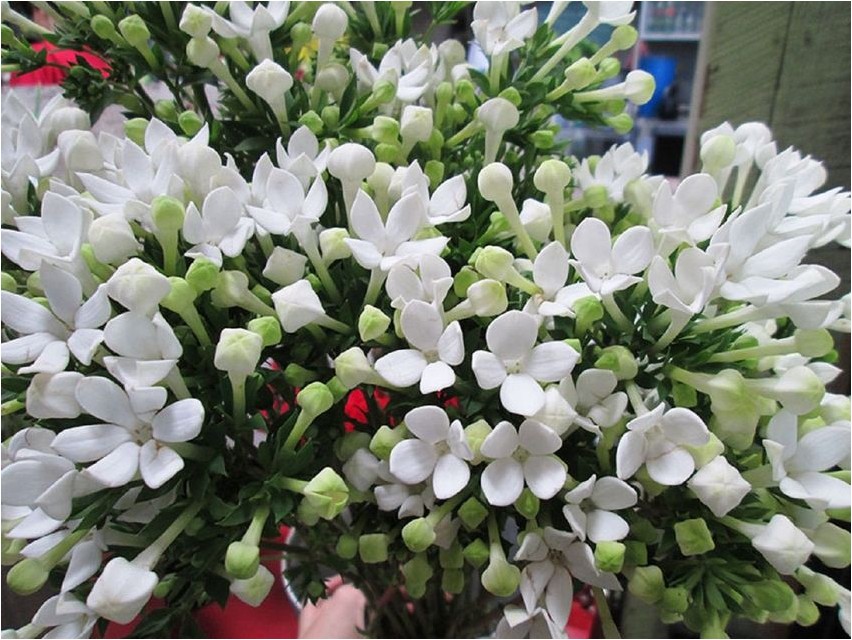
Bouvardia (lat. Bouvardia) is a genus of tropical flowering evergreen herbaceous plants and shrubs. In temperate climates it is grown in greenhouses and as a houseplant.
Glossy green leaves and false umbrellas of inflorescences made of fragrant tubular flowers give the plant a decorative appearance.
What’s in your name
The name of the Bouvardia family preserves the memory of the physician of the French king Louis XIII the Just. He received this honor for combining the position of a doctor with the position of caretaker of the Royal Botanical Garden of Paris. The doctor’s name is Charles Bouvard, years of life from 1572 to 1658.
Description
In the natural conditions of the American tropics, where Bouvardia was born, it is a perennial plant with glossy decorative leaves, like many tropical plants, and fragrant, tubular-shaped flowers forming apical inflorescences. The shape of the leaves can be different, from ovate to lanceolate, with a length of 3 to 11 cm.
The flower tube ends in a limb with four lobes, the color of which can be pink, white, yellow or red. The diameter of the inflorescences of the hybrid species exceeds the similar size of other cultivated Bouvardia species.
Varieties
* Bouvardia jasminiflora (lat. Bouvardia jasminiflora) – most suitable for growing indoors, since it is a dwarf species, growing no more than 60 cm in height. This species received the adjective “jasmine-flowered” for the external similarity of its flowers to jasmine flowers. Their aromas are also similar. White flowers appear in the world in winter.

* Long-flowered Bouvardia (lat. Bouvardia longiflora) – Bouvardia growing in a sunny place reaches a meter in height. Like the previous species, the white flowers of the plant fill the air with a jasmine-like aroma. The leaves have an ovate-pointed shape.
The hybrids created by breeders are inferior to Bouvardia longiflora in height, rising only to 70 cm. The leaves of the hybrids are oval in shape, and the color of the flower blades can be pink, red, white, purple.
* Yellow Bouvardia (Bouvardia flava) – meter-long bushes of this species are distinguished by glossy juicy green leaves and tubular yellow flowers.
Growing
Bouvardia is a very finicky plant, for which it is not very easy to create favorable conditions in an apartment.
The child of the tropics loves places that are well lit, but without direct sunlight. She doesn’t like low or high temperatures. The optimal temperature at which Buvardia feels comfortable is a thermometer mark of plus 13 degrees.
Bouvardia is considered a biennial plant, since in the third year of life it can no longer bloom profusely, and therefore, as a rule, the entire plant is replaced with a new one. Since flowering occurs only on new shoots, faded shoots are cut short.
In addition, during the year it needs a period of rest, which occurs after flowering and reduces the decorative role of the plant. For complete dormancy, the plant requires a temperature below comfortable, but not less than plus 7 degrees, which cannot always be provided in a residential apartment.
Bouvardia is rarely watered during the dormant period, in contrast to the growing season, when regular watering is required.
Soil for flower pots is prepared by mixing coarse and clean river sand, leaf humus or peat soil, turf soil, maintaining the ratio (1: 2: 4).
Propagated by apical or root cuttings.
It is much easier to create favorable conditions by growing Bouvardia in greenhouses. This is what enterprising people do today, growing plants for cutting and sale in flower shops. Bouvardia flowers are often used in wedding ceremonies, decorating the bride’s outfit, or using them for the bride’s bouquet.
Enemies
The enemies of the plant are dampness (not to be confused with humidity), as well as high and low temperatures.