Cadenia dubia
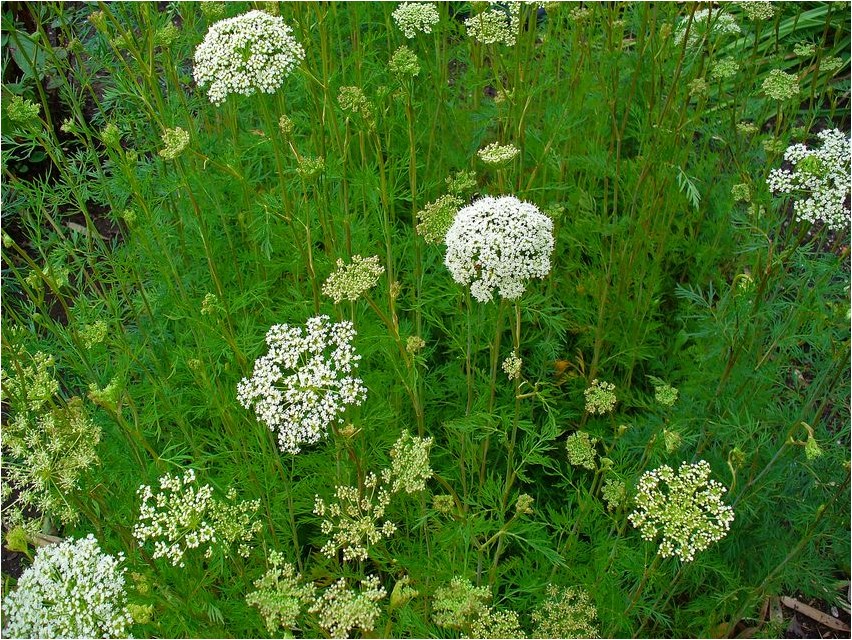
Cadenia dubia is a member of the Apiaceae family. Its Latin name is Kadenia dubia (Schkuhr.) Lavrova et V. Tichomirov.
The family name of Cadenia dubia is Apiaceae Lindl.
Description of Cadenia dubia
Cadenia dubia is a perennial herbaceous plant, reaching heights between thirty and eighty centimeters. The root of this plant is spindle-shaped, sometimes producing shoots near the root collar. This root is solitary and straight, and rounded at the base. The leaves of Cadenia dubia are generally oblong-ovate, bipinnate or almost tripinnate. The umbels are five to seven centimeters across and have twenty to thirty-five glabrous or slightly roughened rays. This plant lacks a complete involucre; the petals can be either ovoid or elliptical, and are approximately one millimeter long. The fruits of the Cadenia dubia are subspherical or broadly ovoid, approximately two to two and a half millimeters long and one and a half to two millimeters wide.
The flowering period of the Cadenia dubia begins in July and ends in August. In the wild, the plant can be found in Ukraine, Belarus, Central Asia, the European part of Russia (except for the Lower Volga region), Western Siberia, and the Angara-Sayan region of Eastern Siberia. The plant prefers pine and birch forests, shrub thickets, meadow steppes, and grass-sedge meadows.
It should be noted that Cadenia dubia is very similar to Cadenia salina. This plant is a perennial polycarpic plant with short rhizomes and adventitious roots: the length of such a plant will vary between twenty-five and sixty centimeters. This plant has very attractive petals, which are colored in shades of white. These petals are glabrous, and the apex is notched.
Description of the medicinal properties of Cadenia dubia
Cadenia dubia has valuable medicinal properties, and its fruit is recommended for medicinal purposes. These valuable medicinal properties are attributed to the plant’s content of osthole, coumarins, and polyacetylene compounds. Interestingly, coumarins have been found in the fruit of this plant.

A decoction made from Cadenia dubia fruit has antispasmodic properties, making it suitable for neuroses.
For angina, a very valuable remedy based on Cadenia dubia is also recommended: to prepare this remedy, take one teaspoon of the fruit per glass of water. Boil the mixture for four to five minutes over fairly low heat, then let it steep for two hours, after which it should be thoroughly strained. Take the resulting remedy, based on Cense dubious, one-third of a glass three to four times a day before meals for about three to four weeks. It’s important to remember that to ensure maximum effectiveness when taking this remedy, you must not only strictly follow all the instructions for preparing it, but also all the rules for taking it.





