Pernettia
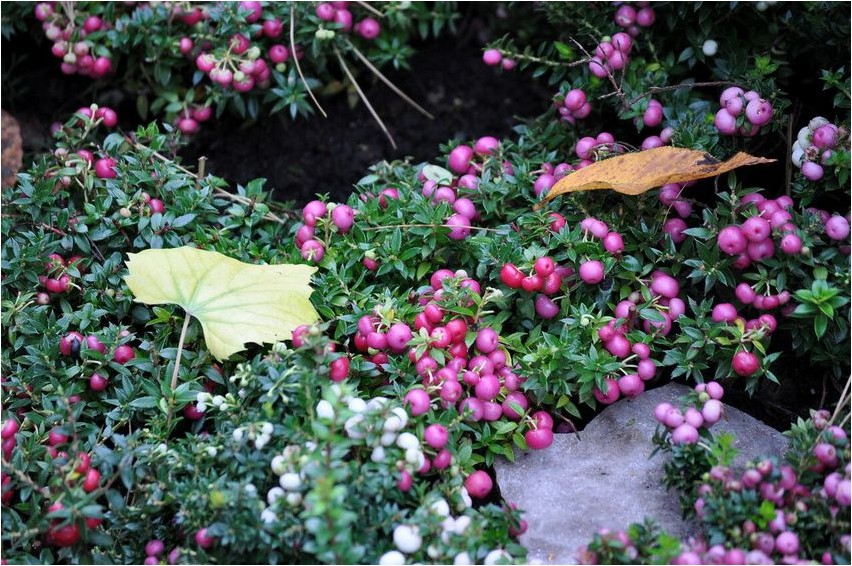
Pernettia (lat. Pernettya) is a genus of evergreen shrubby plants of the Ericaceae family. The most common representative of the genus is the species Pernettia mucronata. Homeland — South Africa. The genus includes about 20 species.
Characteristics of culture
Pernettia is an evergreen subshrub or shrub up to 1 m high with a large number of thin straight stems. The root system is fine-fibrous, branched; during development we form many rhizomatous shoots (or, as they are also called, stolons). The leaves are dark green, small, glossy, oval-lanceolate, pointed at the ends. The flowers are small, pitcher-shaped, white or cream, similar in appearance to Erica flowers, and bloom in the third decade of May.
The fruits are spherical, showy, usually marbled in color from light pink to burgundy. The fruits appear in October — November and do not fall until next spring. The fruits are not eaten, although they are not poisonous. They do not attract birds, but are a wonderful garden decoration. Most of the existing varieties of pernetia are represented only by male and female plants, so it is advisable to plant both of them on the site, otherwise there will be no fruit.
Growing conditions
Pernettia grows well in loamy or clayey, damp, loose, acidic soils. The culture accepts acidic high-moor peat and a mixture of peat with sawdust and pine needles. For acidification, the addition of sulfur is not prohibited. Pernettia has a negative effect on soils with a high lime content. The culture is heat-loving, and without shelter in regions with cold climates it can freeze to the very roots.
The location is preferably sunny, but light shading is permissible. You can grow pernettia as an indoor crop, in which case the plants will delight their owners with beauty and originality. The optimal temperature for growing pernetia at home is 18-20C, in winter — 15-16C. The plant should not be placed close to heating appliances.

Reproduction and planting
Pernettia is propagated by seeds and cuttings. Plants grown by sowing seeds do not retain the properties of the mother plant, so cuttings are the most common method among gardeners. Cuttings are cut in October-November and planted in a substrate consisting of sand and peat in equal proportions. As roots appear on the cuttings, they are planted in separate containers. Plants are transplanted into open ground only after 1-2 years.
Care
Caring for pernetia consists of systematic weeding, fertilizing, watering and pruning. Pruning is necessary to give plants a certain shape; in addition, this procedure promotes the growth of new shoots, which is also important for obtaining beautiful ornamental bushes. Pruning is carried out in early spring, and fertilizing is carried out at the same time. The preparation “Kemira-Universal” can be used as a fertilizer. Water the pernettia as needed; it is not advisable to allow the top layer to dry out.
It is recommended to mulch the soil in the tree trunk zone with fallen pine needles and sawdust. Mulch will not only protect plants from the action of harmful weeds, but will also additionally acidify the soil. In regions with cold climates, pernettias are covered for the winter. Natural material should be used as shelter. The crop is resistant to diseases and pests, but at a high pH value the plants undergo chlorosis, as a result the leaves become yellow. Excess moisture also has a detrimental effect on pernetia, the root system rots, and the berries turn sour.





