Alternanthera
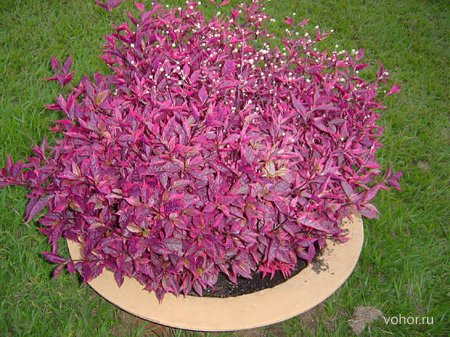
Aliernanthera is a perennial plant that is often grown as an annual. Valued for its unpretentiousness, decorative leaves.
The height reaches up to 20 cm. The flowers are not decorative, because extremely insignificant and ugly. In addition, alternanthera blooms lightly. There are more than 200 images in the genus, many of the images (A. Reinek) grow only in water and are often used for landscaping pools.
Types of Opternanthera
• Various — reaches 15 cm in height; if properly cared for, the plant civilizes a beautiful bush. The leaves are green and red.
• Bettzika — the bush is 20 cm high. The leaves are pale green on top, with yellow and red spots on the bottom.
• Sessile — 20 cm high, leaves are clear green or dark red.
• Sweetheart — reaches almost 10 cm in height, the leaves are shiny, green-red, pubescent below.


care and cultivation of alternanthera
The plant is unpretentious, preferably grows in sunny and shaded areas, but in the sun the leaves take on a more saturated and shiny color. Alternanthera is not picky about soils, but it burns better in nutritious soils with lime. Many intentions, suppose a. sessile, heard best in wetlands, along the banks of unnatural bodies of water (near one water).
The plant is protected by careful watering during the growing season only. An excess of moisture in the ground is bad for the position of the alternantera (with regards to individual images).
Complex mineral fertilizers are used only during the growing season. 1-2 times a month.
For tillering and giving a quick pattern, correct haircuts are carried out. Pruning stimulates the enlightenment of side shoots.
Some gardeners grow alternanthera in containers. For growing in containers, a substrate is used from a mixture of leaf, turf soil, humus and sand. In summer the plant is fed in fresh air, and in winter it is kept in place. In winter, the alternanthera is fed at a temperature of almost 10-15 degrees Celsius, in a bright space. Water according to the limit of need.

alternanthera multiplication
The plant is propagated by distributing the bush and cuttings taken in the fall. The cuttings are placed in a nutrient-rich substrate in a warm, sunny area, in front of a plastic bag. The cuttings are buried in the soil before the first leaf appears. Water moderately, as needed. Once the unusual leaves appear, the plastic bag is decorated. The tips of the growing cuttings are pinched; this pinching promotes the formation of trendy lateral shoots. In May, the young plant is transplanted to bare soil. Two or three cuttings are planted in a single planting hole (or pot, if potted).
Dividing the bush is done in the spring. For this purpose, the mother plant is repotted in the fall and left in place. Throughout the winter, the bush is fed in a sunny area, where the air temperature is maintained at almost 15 degrees Celsius. In winter, water the plant sparingly, depending on the substrate”s drying point. In May, the bush is divided, tall roots are trimmed, and the cuttings are planted in the same area.

uses
alternanthera is used to create carpet flowerbeds, mixed borders, and alpine heaps. It is ideal as a border plant. Many plants are suitable for landscaping the shoreline of ponds.
Diseases and Pests
It can be affected by gray mold as a result of overwatering. It can sometimes be plagued by spider mites, aphids, and whiteflies.