Dichondra
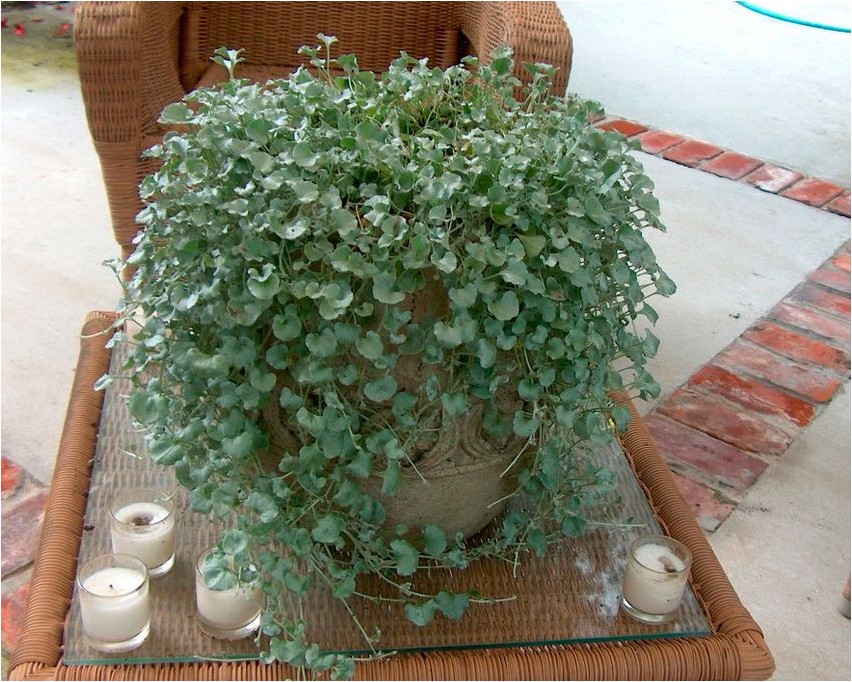
Dichondra (lat. Dichondra) – indoor plant; perennial plant of the Convolvulaceae family. Under natural conditions it grows in tropical and subtropical swamps and rainforests of Australia, New Zealand, East Asia and North America.
Characteristics of culture
Dichondra is a herbaceous evergreen plant with creeping or creeping stems up to 1. 5 m long, forming a dense carpet. The root system is superficial. The leaves are small, opposite, round or kidney-shaped, green or with a silvery bloom, located on short petioles. The flowers are inconspicuous, can be white, purple or light green, reaching 2-3 mm in diameter. Flowering occurs in May–August.
Currently, Dichondra silvery has become widespread among flower growers, or rather its two varieties: “Emerald Falls” (green leaves, medium size, rounded) and “Silver Falls” (leaves are pubescent, silky, silver-ash color). Despite the inconspicuousness of the flowers, dichondra is a highly decorative crop, grown as an hanging plant, capable of creating an unusual background, ideal for flowerpots, hanging baskets and flat containers. Creeping or creeping stems with a large number of leaves located close to each other can create an imitation of a creek or a running stream.
Growing conditions
Dichondra is a photophilous crop, prefers well-lit window sills, develops well in rooms with diffused light, some forms accept partial shade. Dichondra is not picky about soil conditions, but feels better on loamy, well-drained soils enriched with minerals with a pH of 6. 6-8.

The optimal temperature is 18-25C. A sharp decrease in temperature to 10C is highly undesirable; it has a detrimental effect on the general condition of the plant. Dichondra is favorable to high air humidity, so it needs systematic spraying.
Reproduction and planting
Dichondra is propagated by seeds, layering and stem cuttings. Sowing of seeds is carried out in mid-January – early February in low containers. The seeds are not buried in the soil, but only lightly pressed, watered and covered with glass or polyethylene. The optimal maintenance temperature before emergence is 22-24C. Shoots appear in 1-2 weeks. Initially, young plants develop very slowly; dichondras reach maximum decorativeness only after 3-3. 5 months.
Cuttings are the most popular method of propagation among gardeners. This method is considered more effective and simple. Cuttings are cut 5-6 cm long and rooted in a moist, slightly acidic substrate for ornamental foliage plants. Rooting occurs in approximately 10-15 days. An important aspect of this propagation method is maintaining greenhouse conditions; the soil should never be allowed to dry out.
When propagating dichondra by layering, the planting material is spread out on moist soil and pressed down in several places. The containers are covered with plastic. After 7-10 days, when rooting occurs, the stem is cut, and the cuttings are transplanted to another pot.
Care
Dichondras grown in a trailing form require regular pruning. Watering should be moderate, as the plant’s roots do not tolerate stagnant water. The bottom of the pot should be covered with a thick layer of drainage material. Dichondra tolerates short-term drought without any problems and quickly recovers after watering.
The plant responds well to fertilizing with complex mineral fertilizers. Fertilizing is carried out from April to September. Fertilizing is contraindicated in the fall and winter. Dichondra is extremely rarely affected by diseases and pests, so preventative treatments are not required.
Application
It turns out that dichondras are suitable for more than just decorating interiors (offices, apartments, and other spaces). In regions with warm winters, they are often used to create rock gardens, often planted between walkway tiles, under trees, and in patios.