Euphorbia segieri
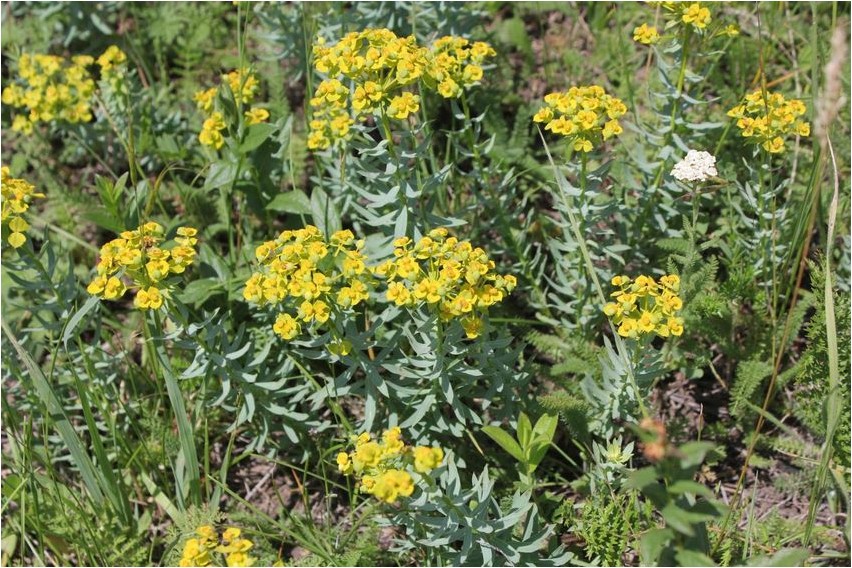
Euphorbia seguierana is one of the plants of the family called Euphorbiaceae, in Latin the name of this plant will be as follows: Euphorbia seguierana Neck. (E. gerardina Jacq.).
As for the name of the milkweed family itself, in Latin it will be: Euphorbiaceae Juss.
Description of Euphorbia segierova
Euphorbia segieri is a perennial herbaceous plant whose height will vary between twelve and fifty-five centimeters. Such a plant is naked and will be colored in bluish tones. The root of Euphorbia segierova is multi-headed and cylindrical, and its stems will be twig-like, at the top they will be endowed with from one to eleven axillary peduncles, the length of which will be about three to six and a half centimeters. There are only five to twelve apical peduncles, their length is one and a half to six centimeters, at the end they will be bifid from one to three times. The involucre leaflets of Euphorbia segierova are three-veined and ovate-lanceolate, and the involucre leaflets can be either reniform or ovate. The glass of this plant is bell-shaped, its length will be about two and a half to three millimeters, and the diameter will be equal to one and a half to two millimeters, such a glass will be bare on the outside, and hairy on the inside. The tricorn of this plant will be conical-ovate, its length is three to four millimeters, and its width is about two and a half to three and a half millimeters, it is glabrous and almost smooth. The seed of Euphorbia segierova will be compressed-ovoid, it is colored in whitish tones, and its length is two to three millimeters.
Euphorbia segierova blooms from May to June, while this plant bears fruit from June to July. Under natural conditions, this plant can be found in the European part of Russia, the Caucasus, Central Asia, Crimea, Ukraine and Belarus.
Description of the medicinal properties of Euphorbia segierova
Euphorbia segiers is endowed with very valuable healing properties, and it is recommended to use the juice, seeds and herbs of this plant for medicinal purposes. The term herb includes the leaves, flowers and stems of Euphorbia segierova.
The presence of such valuable healing properties should be explained by the content of alkaloids, organic acids, vitamin C, saponins, diterpenoid ingenol, triterpenoids, tannins, flavonoids, milky juice, resins, organic acids, rubber, coumarin scopoletin, phenolcarboxylic acids and their following derivatives in the composition of this plant: gallic acid methyl ester, neochlorogenic, chlorogenic and gallic acid. Fatty oil was found in the seeds of Euphorbia segierova.

This plant is endowed with very effective laxative and emetic effects. Dried Euphorbia segierova herb can be brewed as a tea and used for malaria. The milky juice in the amount of three to four drops along with water is used as a laxative, antimalarial and emetic, while externally this healing agent is used to remove calluses and warts.
As for traditional medicine, Euphorbia segierova has also become quite widespread. A decoction prepared from the dry herb of this plant is recommended for use as a laxative for pulmonary tuberculosis. A decoction of milkweed seeds is also used as a laxative. The above-ground part of this plant is endowed with the ability to color tissues in yellow, green and brown tones.
It is important to remember that this plant is poisonous, for this reason it is recommended to exercise extreme caution when handling Euphorbia segierova.





