Alternifolia Spleenwort
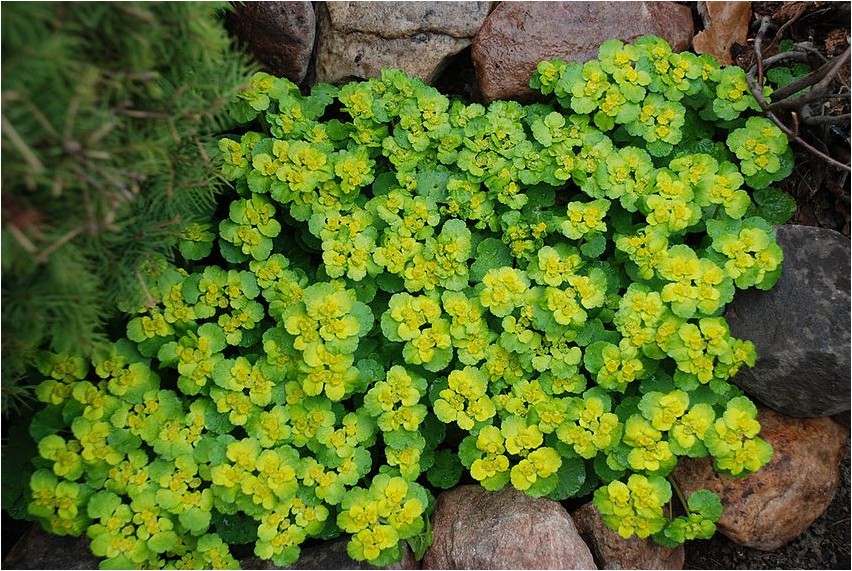
Alternifolia Spleenwort is a member of the Saxifragaceae family. Its Latin name is Chrysosplenium althernifolium L.
As for the family name of Alternifolia Spleenwort, its Latin name is Saxifragaceae Juss.
Description of Alternifolia Spleenwort
Alternifolia Spleenwort is known by many common names: egg-flower, goldenleaf, hernia grass, selenia, devil’s silver, devil’s gold, molden, chicken blindness, goldenspleenwort, and primrose. Alternifolia Spleenwort is a perennial, short-haired herbaceous plant with a slender rhizome, the height of which varies between five and fifteen centimeters. The stem of this plant is solitary, although sometimes there may be several. The stem of the alternating-leaved spleenwort is erect, and may be bare or sparsely hairy below, with one to three alternate leaves. The leaves of this plant are light green, paler beneath. These leaves are rounded-kidney-shaped, with a deeply cordate base and shallowly lobed margins. The basal leaves of the alternating-leaved spleenwort are few and have long petioles, while the cauline leaves are short-petioled. The upper leaves of this plant are greenish-yellow, converging under a corymbose inflorescence to form a flat rosette, with the rosette itself surrounded by similar leaves. The flowers of the alternating-leaved spleenwort, in turn, are gathered into a flat semi-umbel and are yellow in color, with a nectar disk developing at the base of the stamens. The fruit of this plant is a multi-seeded capsule.
The Alternifolia spleenwort blooms in the spring and early summer. In the wild, this plant is found in Belarus, the Far East, Ukraine, the Arctic, European Russia, and Western and Eastern Siberia.
Description of the medicinal properties of the Alternifolia spleenwort
Spleenwort alternate-leaved is endowed with very valuable healing properties, and it is recommended to use the herb of this plant for medicinal purposes. The concept of grass includes flowers, leaves and stems. It is recommended to prepare such medicinal raw materials during the month of June. The presence of such valuable healing properties should be explained by the content of the carbohydrates sedoheptulose, leukoanthocyanidins leukocyanidin and leucodelphinidin in this plant. The leaves of the spleenwort alternate-leaved contain phenols and their derivatives.
The spleen is endowed with a very effective astringent, diuretic, anti-inflammatory, hemostatic and expectorant effect. It is noteworthy that the experiment proved that the herb extract of this plant will have the ability to exhibit antibacterial activity, and the juice, in turn, will exhibit phytoncidal activity. As for traditional medicine, here this plant is very widespread. An infusion prepared on the basis of the herb spleenwort is indicated for use for urinary retention, cough, cystitis, flu, hemoptysis and urolithiasis.

An infusion of the herb of this plant is used for dizziness, respiratory infections, jaundice, and is also used as a general tonic after childbirth and an appetite stimulant.





