Rolled lawn: how to choose the right one, characteristics, care rules
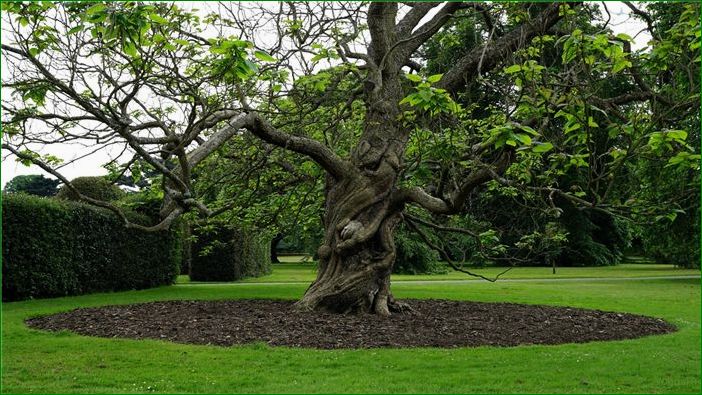
Today, land plots are not just garden beds. Part of the land is given over to lawns. The most common mistake is to plant plants first.
Contents of the article:
- How and where is rolled lawn grown?
- How to choose the right rolls
- What types of lawns are most commonly used?
- Parterre roll lawn
- Elite look of lawn
- Universal roll lawn
- Sports turf
- Laying lawn turf in spring or fall
- We follow the installation rules
- Preparing the site
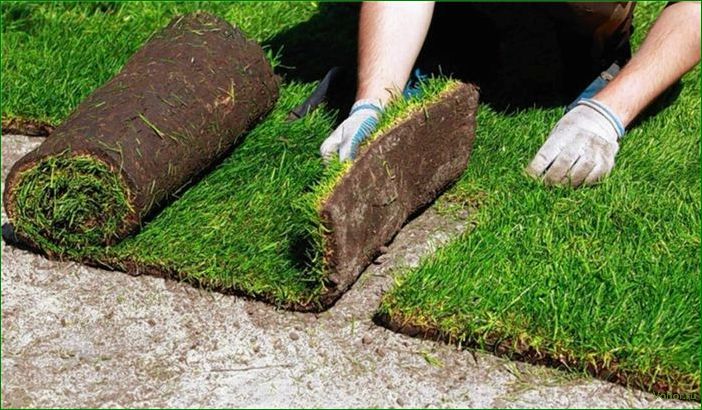
- Laying lawn rolls
- Watering
- What you need to have to lay lawn rolls:
- How to care for a rolled lawn
- If the lawn is frozen in winter
- Rolled lawn, strengths and weaknesses
for those who want a worry-free wait when growing, without sowing herbs, they prefer the roll method of landscaping the area in a short time. Rolled lawns give a noble appearance to a private area, which is part of the landscape design. If you have a question roll lawn buy in Moscow, then in this case you should contact the Mosagrogroup holding.

How and where is rolled lawn grown?
This type of lawn is grown on prepared fields for two to three years. After the turf layer is cut and rolled, it is transported and sold in this form. Ideally, sod should be purchased from the same area where it will be installed. After removal, the turf covering is stored for 24 hours. This is a storage period, after which the turf takes root well, and the root system takes root in a new place. one strip of turf weighs 15 kg, is 0. 4 m wide and 2 m long.
How to choose the right rolls
Turf is considered high if:
- The root system has many white roots;
- No external bald spot or yellow color;
- No weeds;
- The soil is not loose and does not crumble;
- Trimming up to 50 mm;
- Equal thickness along the entire length of the roll;
- No pests;
- Rolls can be stretched and edged. If the grass is not broken, then it is of good quality;
- The smell should be progressive towards the fresh herb.
What types of lawns are most commonly used?
Depending on the growth and intended technology, lawns can be divided into types
Parterre roll lawn
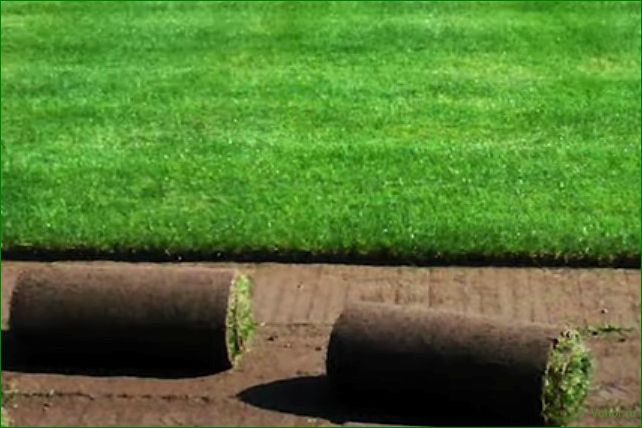
Characterized by a uniform density of durable, dark green sophnina that is finely textured and leafy. It catches well and grows quickly. Popular in areas that form lawns in front of houses and alleys. Used for decorative purposes. Planting is prohibited.
Elite look of lawn
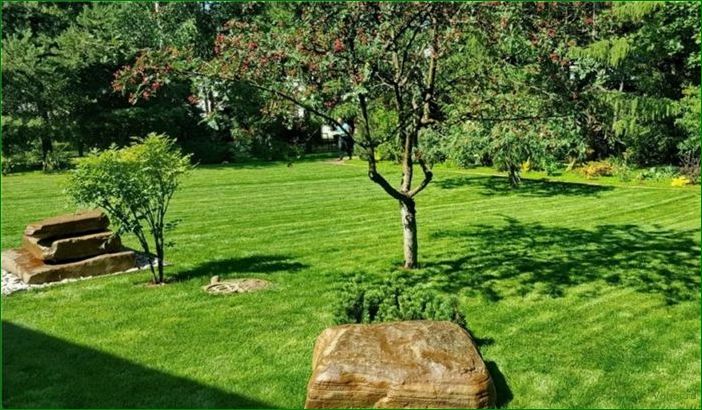
It has a bright emerald color with uniform density. Dense grass, grows quickly and evenly. Tolerates walks well. Adapted to the Russian climate. This lawn is expensive to set up and maintain. Popular in areas that form lawns in front of houses and alleys. Used for decorative purposes. Walking on it is prohibited.

Universal roll lawn
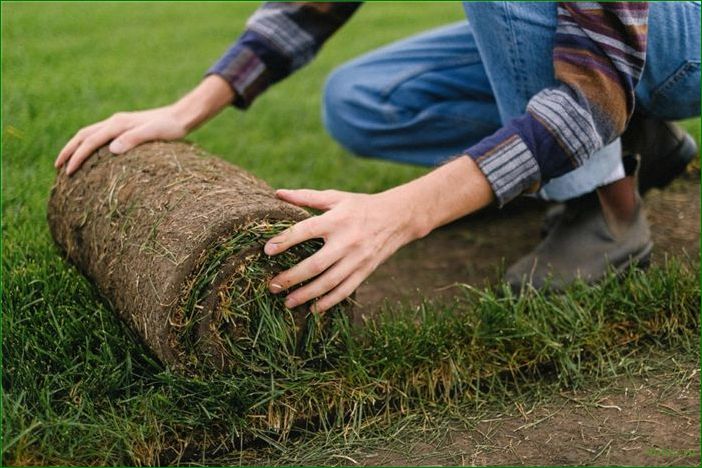
Regular or garden. Designed for walking. The leaves are unpretentious and resistant to normal loads. Herbaceous cover consisting of broad-leaved grasses (Ryegrass, Mutlik), including a mixture of wild oats and several species of Porabita. The main advantage of such lawns is that they can be used on slopes and difficult terrain due to low soil.
Sports turf
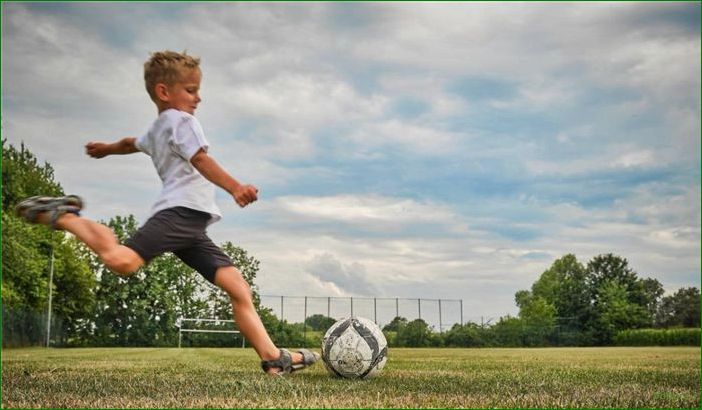
Super resistant type of grass. The grass is not trampled. It takes on its original appearance immediately after trampling. Sports surfaces are installed on golf courses, children”s playgrounds, roadsides and pedestrian areas in urban environments. Sports lawns are sown with a mixture of riot grass and ryegrass.
Laying lawn turf in spring or fall
In the fall — yes. The main thing is that frost sets in. It is not recommended to place lawns in wet weather.
In spring — yes. The soil should warm up. Also, the manufacturer of rolled turf needs to prepare a presentation,
Laying time is the end of April — May.
In the summer months, laying rolled turf is also allowed. In this case, the temperature should not exceed +30°C. Hot lawns are placed in the refrigerator to avoid burns.
We follow the installation rules
Preparing the site
We clear the designated area of debris and weeds under the lawn.
Pour 3-5 cm of drainage into the sand and level the soil.
We pour fertile soil 5-12 cm thick on top of the area.
Any lumpy soil will need to be sifted. It is necessary to use special fertilizers. This contributes to the rapid process of adaptation of the rolled lawn to a new location.
The critical step is to roll the ground so that you can walk on it without falling through.
Laying lawn rolls
It should lie from the edge of a flat surface, be it a curb, fence or paved path.
The first row of rolls should be rolled out one after another on a flat surface.
We cut the first roll of the second row so that the sections of adjacent strips are not on the same line.
We continue to lay the rolls in one direction in a checkerboard pattern. The edges of the strips fit tightly to each other.
We roll the loose lawn with a roller so that the surface is even and any air bubbles that have formed are removed.
Watering
Important: the lawn must be watered before laying.
After connecting the lawn, we begin to water it. It is better to do this manually so that each roll is guaranteed to be even.
15-20 liters of water are consumed per 1 m2; water thoroughly for 7 days. During this period, walking on the lawn is prohibited.
Further watering is carried out as needed. During this period, the grass grows and requires cutting with a lawn mower.
What you need to have to lay lawn rolls:
- Chernozem region;
- Sand;
- Rake;
- Cart;
- Shovels;
- Bayonet shovels;
- Garden links;
- Construction knives;
- Egg hose.
How to care for a rolled lawn
The lawn has been laid. Prepared for watering. Checked for problem areas. We will pay further attention ourselves. You should not forget about mowing and fertilizing if you want your lawn to please you not for 1 year, but for 5-10 years.
Fertilizers are applied once in the spring, and nitrogen fertilizers are applied once in the summer. In autumn, fertilize with manure and phosphate fertilizers.
Excess fertilizer will cause bald spots and yellow spots. Follow the directions on the package.
Make sure to mow once a week and don”t give weeds a chance to break through the dense root mass.
If the lawn is frozen in winter
Lack of snow cover in winter almost always causes lawns to freeze. If there is a lot of snow, it should be evenly distributed over the lawn. In the spring, ice does not accumulate in places where it does not have a beneficial effect on the quality of the lawn. If damaged areas of the lawn are still found, they should be restored by sowing seeds.
Rolled lawn, strengths and weaknesses
We consider these to be strengths:
- Speed when covering large areas of the site;
- Fits well on slopes;
- It can be used for several days;
- We don”t need to understand and select seed mixtures;
- Unpretentious to the soil on which we place it;
- Tolerates low temperatures well;
- It is difficult to cover a dense layer of turf roots;
- You can roll at any time of the year, except winter.
Weaknesses include:
- For starters, it’s expensive;
- It cannot be stored for a long time before planting.
As you can see, there are fewer weaknesses.
The main secret to a good roll-up lawn on your property is its regular watering and frequent mowing. Watering saturates the grass with moisture, giving it the opportunity to develop and absorb nutrients from the soil. Frequent pruning promotes the development of a powerful root system in the cereal, which ensures its resistance to adverse conditions.
There are only two rules to follow:
- Regular watering;
- Frequent mowing.
You will get an excellent result, and the green carpet of the site will delight you with its freshness and beauty.